
The identity industry loves categories.
Workforce Identity. Customer Identity and Access Management. Identity Governance and Administration. Access Management. Partner Identity. Non-Human Identity.
These categories are useful. They help analysts organize markets, help buyers compare vendors, and help vendors explain product capabilities. But they also create a problem.
They make identity look cleaner than it really is.
Modern organizations do not operate in neat identity categories. They operate through relationships.
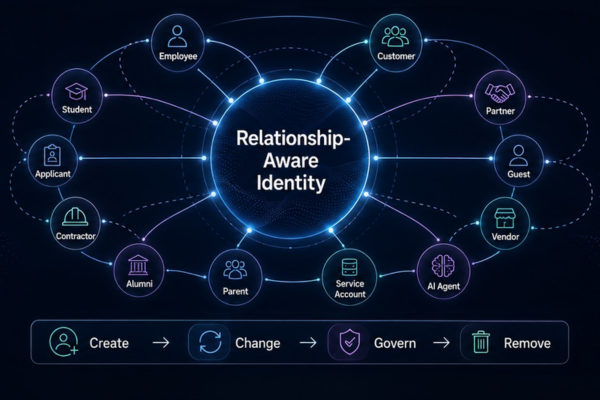
A person may begin as an applicant, become a customer, later join as an employee, return as a contractor, serve as a partner, or re-engage as a guest, member, patient, student, donor, researcher, or advisor.
A vendor may need temporary access. A partner may need delegated administration. A service account may need ownership and accountability. An AI agent may need lifecycle controls, access boundaries, and governance.
These are not just user types. They are relationships.
And every relationship has a lifecycle.
The Old Model: Employees Over Here, Customers Over There
For years, identity programs have often been divided into two large worlds.
Workforce identity focused on employees, contractors, administrators, and internal users. These identities were usually driven by authoritative systems such as HR, ERP, directories, and internal business processes. The main goals were access control, provisioning, governance, security, and compliance.
CIAM focused on customers, consumers, citizens, members, patients, or other external users. These identities were often created through self-registration, digital engagement, consent, identity verification, and user experience workflows. The main goals were ease of access, privacy, fraud reduction, personalization, and a frictionless digital journey.
That division made sense when internal and external identity populations were easier to separate.
It makes less sense now.
The boundary between workforce identity and customer identity is becoming harder to maintain because organizations no longer deal with simple, static populations. They deal with fluid relationships that change over time.
The Reality: Identity Relationships Are Fluid
The question is no longer simply, “Is this person an employee or a customer?”
The better question is:
Who is this person or entity, what relationship do they have with the organization, what access should that relationship allow, who owns it, how should it be governed, and what happens when the relationship changes?
That question applies across every industry.
- In healthcare, a person may be a patient, provider, researcher, volunteer, employee, contractor, or affiliated clinician.
- In financial services, a person may be a customer, advisor, employee, auditor, partner, or third-party service provider.
- In manufacturing, identity may span employees, plant workers, suppliers, distributors, dealers, contractors, customers, applications, and machine identities.
- In government, the same identity ecosystem may include employees, citizens, agencies, contractors, vendors, and delegated administrators.
- In higher education, the complexity becomes especially visible. A person may move across applicant, student, student worker, faculty, staff, alumni, donor, parent, guest, visiting scholar, contractor, and researcher relationships over time. Sometimes those relationships happen in sequence. Sometimes they overlap.
Higher education is not the exception. It is the early warning signal. The same complexity that universities have managed for years is now appearing across healthcare, government, retail, manufacturing, financial services, and the broader enterprise.
Why Separate Identity Silos Create Risk
When identity is managed in disconnected categories, organizations often end up with disconnected systems. One platform manages employees. Another manages customers. Another manages partners. Another manages privileged access. Another tracks access reviews. Another handles service accounts. Another manages guest access. Another handles identity verification.
Each system may solve a specific problem, but the organization still has to answer enterprise-level questions:
- Which relationships does this person currently hold?
- Which accounts are tied to those relationships?
- Which access rights were granted because of each relationship?
- Who owns or sponsors the relationship?
- What should happen when one relationship ends but another remains active?
- How do we prevent role accumulation over time?
- How do we govern access consistently across human and non-human identities?
- How do we prove to auditors that access reflects the current relationship state?
Disconnected systems make these questions harder to answer.
They also create operational debt. Lifecycle logic gets buried in scripts, custom connectors, external workflows, manual ticketing, spreadsheets, and tribal knowledge. Over time, even simple identity changes can become small development projects.
- New population? Project.
- New source system? Project.
- New access rule? Project.
- New exception path? Project.
- New compliance requirement? Project.
That is not sustainable identity management. That is identity fragmentation.
The Next Model: Relationship-Aware Identity
The future of identity management is not simply workforce IAM versus CIAM.
It is relationship-aware identity.
Relationship-aware identity starts with a different assumption. It does not treat identity as a fixed category. It treats identity as a relationship between a person, organization, system, service account, workload, or AI agent and the enterprise.
That relationship has context.
- It has a source.
- It has an owner.
- It has an expected duration.
- It has access requirements.
- It has risk.
- It has governance obligations.
And it changes over time.
This shift matters because identity decisions should not be based only on the existence of an account. They should be based on the current relationship state.
- If the relationship changes, access should change.
- If the relationship expires, access should be removed.
- If the relationship becomes higher risk, governance should respond.
- If the relationship overlaps with another relationship, policy should determine what access remains appropriate.
That is the heart of relationship-aware identity.
Every Identity Is a Relationship
Every identity represents some kind of relationship:
- An employee relationship may be sponsored by HR.
- A contractor relationship may be sponsored by a business owner.
- A student relationship may be driven by a student information system.
- A customer relationship may begin through self-registration or a business transaction.
- A vendor relationship may require temporary or limited access.
- A service account relationship may require an accountable owner.
- An AI agent relationship may require defined purpose, access boundaries, lifecycle controls, and oversight.
The identity record is only part of the story. The relationship is what gives that identity meaning.
That is why identity strategy must move beyond managing accounts and begin managing relationship context.
Every Relationship Has a Lifecycle
Relationships are not static. They are created, changed, suspended, resumed, reviewed, expired, and removed.
A person may start with limited access as an applicant, receive expanded access as a student, gain employee access as a student worker, retain alumni services after graduation, and later return as a contractor or donor.
A vendor may receive access for a project and lose it when the contract ends. A service account may be created for an integration and later become orphaned when the system owner leaves. An AI agent may begin with narrow access but expand over time as new use cases are introduced.
Each lifecycle change should trigger appropriate identity action. That may include provisioning, deprovisioning, access modification, approval, notification, certification, ownership validation, password or credential control, MFA enforcement, or audit review.
If identity systems cannot understand the relationship lifecycle, they cannot consistently enforce the right access at the right time.
Every Lifecycle Needs Governance
Lifecycle automation without governance creates risk. Governance without lifecycle context creates noise. Organizations need both.
They need to know why an identity exists, what relationship justifies its access, who approved it, who owns it, when it should be reviewed, and when it should end.
This is especially important as organizations expand their identity programs beyond traditional employees to include partners, customers, contractors, guests, service accounts, workloads, bots, and AI agents.
Non-human identities make this even more urgent. A service account, integration, workload, or AI agent may not be a person, but it still has access. It still has a purpose. It still needs an owner. It still needs lifecycle controls. It still needs governance.
The identity program of the future must govern both human and non-human relationships through a consistent model.
Why Code-Free Configuration Matters
Complex identity does not have to mean custom code.
In many organizations, identity complexity becomes technical debt because business rules are scattered across scripts, custom workflows, custom connectors, manual procedures, and one-off implementation logic.
That approach may work temporarily, but it becomes harder to maintain as the organization changes.
A relationship-aware identity platform should allow organizations to model complexity through configuration:
- Relationship types
- Lifecycle states
- Authoritative sources
- Ownership and sponsorship
- Access policies
- Workflow approvals
- Notifications
- Provisioning rules
- Self-service processes
- Governance reviews
- Exceptions and expiration rules
The goal is not to eliminate complexity. The goal is to make complexity manageable, visible, governed, and changeable.
Complex identity should be modeled, not hard-coded.
The Fischer Identity Perspective
At Fischer Identity, we believe the market needs to move beyond artificial identity categories and toward relationship-aware identity.
Our platform was built to support complex identity populations through one configurable, code-free lifecycle and governance model. That includes workforce, student, contractor, guest, vendor, partner, alumni, customer-like, service account, and non-human identity scenarios.
This is not theoretical. We already support environments where identities move across multiple relationships over time and where access must follow those changes with precision.
Higher education has proven the model because it forces identity platforms to handle some of the most complex lifecycle and relationship scenarios in the market. But the need is now much broader.
Modern organizations across industries are facing the same problem: identity relationships are becoming more fluid, more interconnected, and harder to govern through disconnected systems.
That is why the next stage of identity management is not about choosing between workforce IAM and CIAM. It is about managing every relationship with continuous identity control.
One Platform. Every Relationship. Continuous Identity Control.
The market may still be organized around categories, but organizations operate through relationships.
Every identity is a relationship. Every relationship has a lifecycle. Every lifecycle needs governance.
That is the foundation of relationship-aware identity, and it is why Fischer Identity is focused on helping organizations manage the full lifecycle of identity relationships through one configurable platform.
Not separate identity silos. Not hard-coded lifecycle logic. Not artificial categories that fail to reflect the real world.