Identity programs have traditionally focused on accounts, credentials, roles, groups, and access rights.
Those things matter. They are the mechanics of identity management.
But they are not the whole story.
An identity is not just a login. It is not just an account in a directory. It is not just a record in HR, a row in a student system, a profile in a customer portal, or a service account tied to an application.
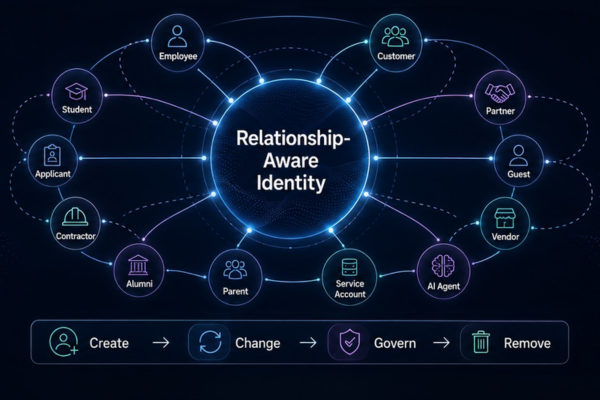
Every identity represents a relationship. That relationship may be between a person and an organization. It may be between a vendor and an enterprise. It may be between a service account and an application. It may be between an AI agent and the business process it is allowed to support.
The relationship is what gives the identity meaning. Without that context, identity becomes a collection of accounts. With that context, identity becomes a governed business function.
The Account Is Not the Relationship
Too often, identity programs begin and end with the account.
Does the person have an account? Can they authenticate? Are they in the right group? Do they have the right role? Can they access the application?
Those are important questions, but they are not enough. They describe access mechanics. They do not fully explain why the access exists, who owns it, how long it should last, or what should happen when the business relationship changes.
The better questions are:
- What relationship does this identity represent?
- Who or what established that relationship?
- Who owns or sponsors it?
- What access is appropriate for that relationship?
- What level of assurance is required?
- When should the relationship change, expire, or be reviewed?
- What should happen if the relationship overlaps with another relationship?
These questions move identity from account administration to relationship governance.
Relationships Create Identity Context
A person can have many types of relationships with an organization. They may be an employee, contractor, customer, partner, student, applicant, alumni, patient, vendor, researcher, guest, donor, advisor, or member.
Each relationship carries different expectations:
- An employee relationship may be driven by HR and governed by job role, department, manager, location, employment status, and regulatory requirements.
- A contractor relationship may require a business sponsor, expiration date, limited access, and periodic validation.
- A customer relationship may begin through self-registration, identity verification, consent, and digital engagement.
- A student relationship may begin as an applicant, evolve into an enrolled student, expand into a student worker role, and later shift into an alumni relationship.
- A vendor relationship may require temporary access tied to a contract, project, or support obligation.
- A service account may not be a person, but it still needs an owner, purpose, scope, credential control, and lifecycle.
- An AI agent may require even more explicit guardrails: defined purpose, approved access boundaries, accountable ownership, monitoring, and deactivation rules.
The identity record alone cannot fully answer those questions. The relationship can.
One Person, Multiple Relationships
The real world rarely fits into clean identity categories. One person may have more than one relationship with the same organization at the same time.
Examples Include:
- A customer may become an employee.
- An employee may also be a patient.
- A student may also be a student worker.
- An alumni may also be a donor.
- A vendor may also be a contractor.
- A researcher may also be a guest, collaborator, or temporary affiliate.
- A parent may need delegated access related to a student, but should not be treated as the student.
These overlapping relationships create practical identity challenges.
- If one relationship ends, should all access be removed? Or should some access remain because another relationship is still valid?
- If a person has two active relationships, which one determines access?
- If one relationship carries higher risk, should it change how authentication or governance is applied?
- If an external user becomes internal, should the organization create a second identity, merge identity records, preserve history, or transform the relationship state?
These are not theoretical questions. They appear constantly in modern identity programs. They are also the reason traditional workforce-versus-customer identity models are no longer enough.
Relationships Have Owners
Every meaningful identity relationship needs ownership.
- For employees, ownership may come from HR, a manager, or a department.
- For contractors, ownership may come from a business sponsor.
- For students, ownership may come from admissions, the registrar, HR, or another institutional source depending on the relationship.
- For vendors, ownership may come from procurement, legal, a project owner, or an application owner.
- For service accounts, ownership should be tied to a person, team, application, or business function.
- For AI agents, ownership should be explicit from the beginning. Someone must be accountable for what the agent can access, what it can do, what data it can process, and when it should be changed or disabled.
Ownership matters because access without ownership becomes orphaned risk.
- An account with no owner is a problem.
- A service account with no owner is a risk.
- An external relationship with no sponsor is a gap.
- An AI agent with no accountable business owner is a governance failure waiting to happen.
Relationship-aware identity makes ownership part of the model, not an afterthought.
Relationships Have Lifecycles
Every relationship changes. Some are created through hiring. Some through enrollment. Some through registration. Some through contracting. Some through delegation. Some through application integration. Some through business partnership.
But creation is only the beginning.
Relationships may be updated, extended, suspended, renewed, reviewed, transferred, expired, or terminated.
A strong identity program must understand those changes and translate them into action.
- When a person changes jobs, access should change.
- When a contractor’s engagement ends, access should be removed.
- When a student graduates, access should transition, not simply disappear without thought.
- When a vendor contract ends, sponsored access should expire.
- When a service account is no longer tied to an active application or owner, it should be reviewed or retired.
- When an AI agent is repurposed, its access boundaries should be reevaluated.
Lifecycle is where identity becomes operational. Governance is where identity becomes accountable.
Relationships Require Governance
Relationship-aware identity is not only about creating and changing access. It is also about proving that access remains appropriate.
Governance should answer:
- Why does this identity exist?
- Which relationship justifies it?
- Who owns or sponsors the relationship?
- What access was granted because of it?
- When was it last reviewed?
- What policy applies?
- What should happen when the relationship ends?
Access reviews are more useful when reviewers understand relationship context:
- A manager reviewing an employee’s access is one scenario.
- A sponsor reviewing contractor access is another.
- An application owner reviewing service account access is another.
- A data owner reviewing an AI agent’s permissions is another.
Without relationship context, governance becomes a checklist. With relationship context, governance becomes meaningful oversight.
Relationships Should Be Configured, Not Hard-Coded
Relationship complexity is not going away. Organizations will continue to support more identity populations, more access paths, more external relationships, more non-human identities, and more AI-enabled processes. The answer cannot be endless custom code.
A relationship-aware identity platform should allow organizations to model relationships through configuration:
- Relationship type
- Source of authority
- Owner or sponsor
- Lifecycle state
- Start and end dates
- Access rules
- Approval paths
- Authentication requirements
- Governance requirements
- Expiration and renewal rules
- Deprovisioning actions
- Exception handling
This matters because business relationships change. If every change requires code, scripts, custom workflows, or professional services, the identity program becomes brittle.
Complex identity should be modeled, not hard-coded.
Relationship-Aware Identity and Continuous Identity Control
Relationship-aware identity also changes how organizations think about control.
Traditional identity programs often focus on point-in-time events:
- A user is hired.
- An account is created.
- A role is assigned.
- A review is completed.
- A user is terminated.
Those events matter, but modern identity requires more than event-based administration. It requires continuous alignment between relationship state and access state.
If the relationship changes, identity state should change. If identity state changes, access should change. If access changes, governance should have visibility.
That is continuous identity control.
It is not simply about automating onboarding and offboarding. It is about keeping access aligned with the current relationship, current policy, and current risk.
The Fischer Identity Perspective
At Fischer Identity, we believe every identity is a relationship.
That belief reflects the complexity our platform already supports across workforce, student, contractor, guest, vendor, partner, alumni, customer-like, service account, non-human identity, and future AI agent scenarios.
In highly complex environments such as higher education, this model is already essential. One person may move across applicant, student, employee, alumni, guest, researcher, contractor, donor, and parent-related scenarios over time.
But the need is broader than higher education.
Healthcare, financial services, manufacturing, retail, government, and enterprise organizations are all facing the same reality. Identity relationships are becoming more fluid, more interconnected, and harder to govern through disconnected systems.
Fischer Identity helps organizations manage those relationships through one configurable, code-free lifecycle and governance platform.
We manage the relationship, not just the account.
One Platform. Every Relationship. Continuous Identity Control.
The future of identity management will not be defined by whether a user fits neatly into workforce IAM, CIAM, partner identity, or non-human identity.
The future will be defined by whether organizations can understand and govern the relationship behind the identity.
Every identity is a relationship. Every relationship has a lifecycle. Every lifecycle needs governance.
And every organization needs a way to manage that complexity without building a maze of custom code, disconnected tools, and manual processes.
That is the foundation of relationship-aware identity.