For years, identity programs have been built around lifecycle events.
- A person is hired.
- An account is created.
- A role is assigned.
- A manager approves access.
- A user transfers departments.
- A contractor reaches an end date.
- An employee leaves.
- An account is disabled.
These events matter. They are the operational backbone of identity lifecycle management. But lifecycle events are no longer enough.
Modern organizations need more than event-based identity administration. They need continuous identity state. That means identity should not only react when something happens. Identity should continuously reflect the current relationship, current access, current ownership, current policy, and current risk.
In a world where identity relationships are fluid, overlapping, and constantly changing, the goal is not simply to process lifecycle events faster. The goal is to keep identity accurate. Continuously.
Lifecycle Events Were the Starting Point
Traditional identity lifecycle management was built around clear business events.
- When someone is hired, create accounts and assign access.
- When someone changes jobs, update access.
- When someone leaves, remove access.
This model made sense when identity populations were mostly workforce-driven and lifecycle signals were relatively straightforward. HR was often the primary source of authority. Employment status drove access. Job role, department, location, and manager helped determine what a person should receive. That model remains important. But it is incomplete.
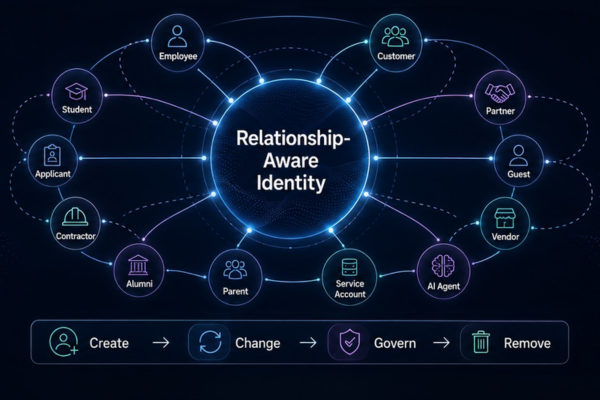
Today, organizations manage far more than employee hire, transfer, and termination events. They manage applicants, customers, partners, contractors, vendors, students, guests, alumni, patients, members, service accounts, workloads, bots, and AI agents. Many of these identities do not follow a simple hire-to-retire pattern.
- They may have multiple relationships.
- They may have temporary access.
- They may be sponsored by someone other than H R.
- They may move between internal and external status.
- They may disappear and later return.
- They may not be human at all.
The lifecycle event model still matters, but it must evolve.
The Problem With Event-Only Identity
Event-based identity management assumes that if the right trigger occurs, the right identity action will followThat is useful, but it leaves an important question unanswered: What happens between events?
- Access may be granted during onboarding, but does it remain appropriate six months later?
- A contractor may be extended, but was the sponsorship reviewed?
- A student may become an employee, but were conflicting or overlapping access rights resolved?
- A vendor account may remain active after a project ends because no one triggered the removal event.
- A service account may outlive the application owner who originally created it.
- An AI agent may accumulate access as new use cases are added, but no single lifecycle event may capture the full risk picture.
This is where event-only identity breaks down. It assumes that the organization knows when something changed and that the change was processed correctly. In reality, identity state can drift.
- Access can accumulate.
- Ownership can become unclear.
- Relationships can expire without action.
- Governance can become disconnected from the actual business context.
The result is identity risk hiding in the gaps between lifecycle events.
Identity State Drift Is the Real Risk Identity risk is often not caused by one failed event. It is caused by drift. Drift happens when the current identity state no longer matches the current business relationship.
Examples include:
- A contractor still has access after the engagement ends.
- A student worker retains employee access after the job ends.
- An alumni retains active student access that should have transitioned.
- A vendor account remains active with no current sponsor.
- A service account no longer has a valid owner.
- An employee changes roles but keeps access from the previous role.
- An AI agent gains access to data outside its approved purpose.
- A guest account is extended repeatedly without proper review.
None of these problems may look dramatic at first. But over time, drift creates real security, compliance, and operational risk.
Identity programs cannot rely only on initial provisioning and occasional review to catch this. They need a model that continuously compares what access exists against what the current relationship justifies. That is continuous identity state.
What Continuous Identity State Means
Continuous identity state means that identity is managed as an active, governed condition rather than a series of disconnected tasks.
It answers questions like:
- What relationships does this identity currently have?
- What access is justified by those relationships?
- Who owns or sponsors each relationship?
- What lifecycle state is each relationship in?
- Which policies apply right now?
- What has changed since the last review?
- Does current access still match current relationship state?
- Are there expired, orphaned, excessive, or conflicting access rights?
- What should be changed automatically, routed for approval, reviewed, or removed?
This is a shift from identity as event processing to identity as continuous control.
Lifecycle events still matter. They remain important signals. But they are part of a larger model that keeps identity state aligned with relationship state over time.
Relationship State Should Drive Access State
In a relationship-aware identity model, access should be tied to the relationship that justifies it.
- An employee relationship may justify access to internal systems.
- A contractor relationship may justify access to a project workspace for a defined period.
- A student relationship may justify access to academic systems.
- A student worker relationship may justify additional workforce access.
- An alumni relationship may justify continued access to selected services.
- A vendor relationship may justify temporary support access.
- A service account relationship may justify system-to-system access tied to an owner and application.
- An AI agent relationship may justify narrowly scoped access to data, tools, or workflows based on its approved purpose.
When the relationship changes, access should change with it.
- If the relationship ends, access should be removed or transitioned.
- If the relationship expands, access may need approval.
- If the relationship becomes higher risk, authentication or review requirements may increase.
- If multiple relationships overlap, policy should determine the appropriate access state.
This is where continuous identity becomes powerful. It allows the organization to maintain alignment between relationship, access, ownership, and governance.
Governance Must Become More Continuous Too
Traditional access reviews often happen periodically.
- Quarterly.
- Semiannually.
- Annually.
Those reviews are useful, but they are not enough by themselves.
A review performed once or twice a year cannot fully control access that changes every day.
Modern governance needs to become more event-aware and state-aware.
That does not mean every access change needs a full certification campaign. It means governance should be triggered by meaningful changes in relationship state, access risk, ownership, or policy.
For example:
- A contractor reaches an end date and requires sponsor validation.
- A user accumulates access from multiple relationships.
- A service account loses its owner.
- A high-risk entitlement is assigned outside normal policy.
- A student worker’s employment ends but academic access remains.
- An AI agent requests expanded permissions beyond its approved purpose.
- A guest account is renewed multiple times.
These scenarios require governance at the moment risk changes, not only during the next scheduled review cycle.
Continuous identity state does not replace governance. It makes governance more timely, more contextual, and more meaningful.
Continuous Identity Requires Good Signals
Continuous identity state depends on signals.
Those signals may come from HR systems, student systems, CRM platforms, contractor management systems, directories, access systems, ticketing platforms, governance reviews, security tools, application owners, business sponsors, and risk engines.
Signals may include:
- Employment status
- Enrollment status
- Contract end date
- Sponsor validation
- Department change
- Role change
- Location change
- Access request
- MFA status
- Risk event
- Ownership change
- Account activity
- Application change
- Credential rotation
- Review outcome
- Policy exception
The key is not merely collecting signals. The key is translating signals into governed identity action. A signal without action is just information. A signal connected to policy, workflow, lifecycle, and governance becomes identity control.
Continuous identity state cannot depend on endless custom code.
If every new signal, relationship type, lifecycle rule, access policy, exception, or governance trigger requires development work, the model will not scale.
Modern organizations change too quickly. New populations appear. Applications change. Business processes evolve. Compliance expectations shift. AI and automation introduce new identity patterns.
A continuous identity platform must allow organizations to configure how identity state is calculated and controlled.
That includes configuration for:
- Authoritative sources
- Relationship types
- Lifecycle states
- Access policies
- Ownership rules
- Approval workflows
- Expiration logic
- Renewal processes
- Governance triggers
- Exception handling
- Deprovisioning actions
- Notifications
- Integrations
The goal is to make identity state visible, governed, and adaptable without turning every change into a development project. Complex identity should be modeled, not hard-coded.
Why This Matters for Non-Human and AI Identities
Continuous identity state is not only about people. Non-human identities make the need even more urgent.
Service accounts, workloads, bots, integrations, APIs, and AI agents often do not follow traditional workforce lifecycle events. They may not have a hire date or termination date. They may not have a manager in the traditional sense. They may run continuously in the background for years. That makes ownership, purpose, access boundaries, credential management, and lifecycle governance critical.
- A service account should have a current owner.
- A workload should have a defined purpose.
- An integration should have approved access.
- An AI agent should have clear boundaries and governance.
If any of those conditions changes, identity state should change. This is why relationship-aware identity and continuous identity state belong together. Every identity, human or non-human, represents a relationship. That relationship must remain governed over time.
The Fischer Identity Perspective
At Fischer Identity, we believe identity should not be managed as a series of disconnected lifecycle events. It should be managed as a continuous, governed state. That state should reflect the current relationship between the identity and the organization.
Fischer Identity supports this approach through one configurable, code-free lifecycle and governance platform. Our model allows organizations to manage complex identity populations, lifecycle rules, access policies, workflows, approvals, ownership, and governance processes across human and non-human identities. This is especially important in complex environments where identities do not fit neatly into traditional categories such as workforce IAM or CIAM. Higher education has proven this complexity for years through student, applicant, employee, alumni, guest, parent, contractor, researcher, and service account scenarios.
But the same need now exists across healthcare, financial services, manufacturing, retail, government, and enterprise organizations.
The market is moving from lifecycle events to continuous identity state.
Fischer Identity is already built for that shift.
One Platform. Every Relationship. Continuous Identity Control.
Lifecycle events are important. But they are not enough.
Modern identity requires continuous awareness of relationship state, access state, ownership, policy, and governance.
- When the relationship changes, identity state should change.
- When identity state changes, access should change.
- When access changes, governance should have visibility.
That is continuous identity control.
Every identity is a relationship. Every relationship has a lifecycle. Every lifecycle needs governance.
And every organization needs a way to keep identity aligned with reality.