Identity is not getting simpler. Organizations are managing more populations, more applications, more relationships, more access paths, more compliance expectations, and more non-human identities than ever before.
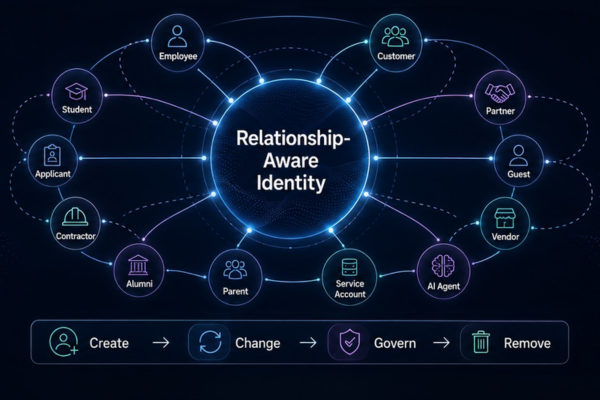
Employees, contractors, vendors, partners, customers, guests, students, alumni, patients, members, service accounts, workloads, bots, and AI agents all need identity controls. They all need lifecycle management. They all need access boundaries. They all need governance.
That complexity creates a hard question: How do organizations automate identity without turning every business change into a development project? That question matters because many identity programs do not fail from lack of effort. They fail because complexity gets buried in custom code, scripts, external workflows, custom connectors, brittle rules, and professional services dependencies.
The result is predictable.
- New population? Project.
- New source system? Project.
- New access policy? Project.
- New approval path? Project.
- New exception process? Project.
- New compliance requirement? Project.
At some point, identity automation becomes another form of technical debt. It does not have to be that way.
Complex identity should be modeled, not hard-coded.
Configuration Is Not Always the Same as Code-Free
The identity market has started to talk more about configuration instead of customization. That is a positive shift. But the phrase can be misleading if it is not clearly defined. Saying a vendor does not alter the underlying product codebase is not the same as saying the customer avoids custom implementation debt.
- A JSON workflow can still become technical debt.
- A custom connector can still become technical debt.
- A rule, script, transform, external automation, or partner-built extension can still become technical debt.
The real question is not simply: Did we modify the product code?
The better question is: Can the customer maintain, govern, audit, and change the identity process inside the platform without needing developers every time the business changes?
That is the difference. Identity programs do not fail because someone wrote code in the wrong place. They fail because every lifecycle change becomes a mini development project.
If a business analyst, identity administrator, or authorized platform owner cannot understand and change the process without digging through code, scripts, and external dependencies, then the organization has not really escaped customization. It has only moved it somewhere else.
Why Complex Organizations Need Code-Free Automation
Complex organizations do not have simple identity patterns.
- They have multiple authoritative sources.
- They have overlapping relationships.
- They have users who move between populations.
- They have temporary access needs.
- They have exceptions.
- They have mergers, acquisitions, new systems, policy changes, regulatory obligations, and business units that do things differently.
- They have service accounts that need owners.
- They have AI agents that need access boundaries.
- They have security teams asking for stronger control and business teams asking for faster access.
If identity automation depends on custom code every time one of those realities changes, the program will eventually slow down, become expensive, or lose control.
Code-free identity automation matters because it makes complexity manageable.
It allows organizations to define identity processes through visible, governed configuration rather than hidden implementation logic.
That does not mean identity becomes easy. It means identity becomes maintainable.
The Problem With Hidden Implementation Debt
Implementation debt is dangerous because it often looks like progress at first.
- A script solves a one-off provisioning issue.
- A custom workflow handles an exception.
- A partner-built connector bridges a gap.
- A transform fixes an attribute problem.
- An external automation updates a downstream system.
Each decision may be reasonable in isolation. But over time, those decisions accumulate. Eventually, the organization no longer has a clean identity architecture. It has a maze.
- When something breaks, only a few people know where to look.
- When the business changes, developers are needed.
- When an auditor asks how access is granted, the answer spans multiple tools.
- When a customer wants to change a lifecycle rule, the change becomes a project.
- When the original implementation team leaves, institutional knowledge leaves with them.
That is the hidden cost of identity customization. The organization may not have modified the vendor’s core codebase, but it still owns a fragile identity ecosystem.
What Code-Free Should Mean
Code-free identity automation should mean more than “we did not change the product code.” It should mean identity logic can be configured, reviewed, governed, and changed inside the platform.
- It should mean lifecycle rules are visible.
- It should mean workflows are understandable.
- It should mean access policies are manageable.
- It should mean approvals, notifications, exceptions, and deprovisioning actions are not buried in scripts.
- It should mean authorized administrators can adapt identity processes as the organization changes.
- It should mean the customer is not dependent on developers or professional services for every routine lifecycle change.
A truly code-free identity platform should allow organizations to configure:
- Identity sources
- Relationship types
- Lifecycle states
- Attribute rules
- Provisioning policies
- Deprovisioning policies
- Access rules
- Approval workflows
- Notifications
- Password and self-service processes
- Ownership and sponsorship models
- Access review logic
- Expiration and renewal rules
- Exception paths
- Connector-driven integrations
The goal is not to eliminate complexity. The goal is to make complexity visible, governed, and changeable.
Relationship-Aware Identity Requires Configurable Logic
Relationship-aware identity depends on understanding the context behind the identity.
- An employee relationship may be driven by HR.
- A customer relationship may begin through self-registration.
- A contractor relationship may require sponsorship and an expiration date.
- A student relationship may begin as an applicant, become enrolled, shift into a student worker role, and later transition to alumni.
- A vendor relationship may require limited access for a defined project.
- A service account may require an owner, purpose, credential control, and review schedule.
- An AI agent may require defined access boundaries, approved use cases, and continuous governance.
These relationships cannot be managed well if each variation requires custom development. They need a configurable model.
The organization should be able to define the relationship, its source, its owner, its lifecycle state, its access rules, and its governance requirements inside the platform. That is how identity moves from account administration to relationship-aware lifecycle control.
Code-Free Does Not Mean Control-Free
There is a misconception that code-free means less control. In identity, the opposite should be true. Code-free identity automation should increase control because it brings logic into the platform where it can be governed.
- When workflows, policies, rules, and lifecycle actions are visible, they can be reviewed.
- When they are configurable, they can be changed without risky development cycles.
- When they are standardized, they can be reused.
- When they are tied to governance, they can be audited.
- When they are managed inside the platform, the organization has a clearer understanding of how identity decisions are made.
The issue is not whether logic exists. Identity requires logic. The issue is where that logic lives and who can manage it. If the logic lives in custom scripts, hidden transforms, external automations, and undocumented implementation choices, the customer does not really control the identity process. If the logic lives in governed platform configuration, the customer has a better chance of maintaining control as the organization changes.
Why This Matters for Continuous Identity State
Continuous identity requires identity state to remain aligned with relationship state, access state, ownership, policy, and risk. That cannot happen if identity logic is scattered across disconnected systems.
Signals from HR, student systems, CRM platforms, contractor systems, security tools, governance reviews, and business owners must be translated into governed identity action.
- A contractor end date should trigger validation or removal.
- A student worker job ending should remove employment access without breaking academic access.
- A service account losing an owner should trigger review.
- A vendor relationship ending should remove sponsored access.
- An AI agent requesting expanded access should require policy evaluation and approval.
Those actions require rules, workflows, ownership, and governance.
If every signal requires custom code to interpret and act on it, continuous identity becomes difficult to sustain.
Code-free configuration makes continuous identity practical because it allows the organization to adapt rules and workflows as signals, relationships, and policies change.
The Best Test: Can the Customer Change It?
A simple test separates true code-free identity automation from configuration theater:
When the business changes, can the customer change the identity process inside the platform? Can they make this change without holding developer skills?
Can they:
- Add a new relationship type?
- Change an approval path?
- Update a lifecycle rule?
- Modify an access policy?
- Create an exception process?
- Adjust an expiration rule?
- Understand how the process works without reading code?
- Explain it to an auditor?
- Govern it over time?
If the answer is no, then the organization still has implementation debt.
It may be called configuration. It may be packaged as extensibility. It may not modify the vendor’s core codebase. But if the customer cannot maintain it, govern it, and change it, the debt remains.
The Fischer Identity Perspective
At Fischer Identity, we believe complex identity should be modeled, not hard-coded. Our platform is designed to support complex identity populations through configurable lifecycle, access, workflow, password, self-service, and governance capabilities.
This matters because modern organizations do not fit neatly into workforce IAM, CIAM, IGA, Access Management, Partner Identity, or Non-Human Identity categories. They manage relationships. Employees, contractors, vendors, partners, students, applicants, alumni, guests, customer-like users, service accounts, and AI agents all require lifecycle and governance controls.
Fischer Identity helps organizations manage those relationships through one configurable, code-free identity platform. That means identity processes can be adapted as the business changes without turning every change into a custom development effort. This is especially important in complex environments such as higher education, where one person may move across applicant, student, employee, alumni, guest, researcher, contractor, donor, and parent-related scenarios over time.
But this is not just a higher education problem.
Healthcare, financial services, manufacturing, retail, government, and enterprise organizations are all facing the same reality: identity relationships are becoming more fluid, more interconnected, and harder to manage through disconnected systems and custom implementation logic.
One Platform. Every Relationship. Continuous Identity Control.
The future of identity automation is not about hiding custom logic under a nicer label. It is about giving organizations a governed, configurable way to manage identity complexity.
Every identity is a relationship. Every relationship has a lifecycle. Every lifecycle needs governance.
And every organization needs identity automation that can change as the business changes.
Code-free does not mean simplistic.
- It means sustainable.
- It means visible.
- It means governable.
- It means the customer can manage identity complexity without inheriting a maze of custom code, scripts, and brittle implementation debt.
That is the foundation of relationship-aware identity