A recent TechRadar article on verified workforce identity and agentic trust caught my attention because it speaks directly to something many of us in the identity space are already seeing: identity is no longer just about helping people log in. It is about continuously proving that the person, system, service account, automation, or AI agent requesting access is legitimate, authorized, and operating within the right boundaries.
That may sound like an emerging topic, but for those of us who have worked deeply in Identity and Access Management (IAM), it is really the next evolution of work we have been doing for years. The language is changing, the threats are changing, and AI is accelerating the conversation, but the underlying principle remains the same: organizations need to know who or what is accessing their systems, why that access exists, how it was approved, whether it is still appropriate, and when it should be removed.
This is where IAM becomes much larger than Single Sign-On (SSO) or Multi-Factor Authentication (MFA). SSO and MFA are important controls, but they are not a complete identity strategy. They help answer whether someone can authenticate. They do not fully answer whether that identity should exist, whether the person behind it was properly verified, whether access is still appropriate, or whether the organization can prove its decisions later.
That distinction matters more now than ever.
I Have Seen the Problem Firsthand
This topic is not theoretical for me. I personally encountered what appeared to be an AI-driven or bot-assisted applicant during a hiring process. During the applicant’s screening call, I asked a specific question that a legitimate candidate should have been able to answer. The response did not make sense. Shortly after that, the “candidate” disconnected from the call and disappeared.
Reference checks later revealed that the person did not exist.
That experience changes how you think about workforce identity. It is one thing to read about synthetic identities, deepfakes, fake applicants, and AI-assisted fraud. It is another thing to see it appear inside a normal business process that many organizations still treat as reasonably trustworthy.
Hiring and onboarding have traditionally been treated as the starting point for trust. The organization interviews a person, validates basic information, extends an offer, creates a record, and eventually issues digital access. But if the person entering that process is not real, or if the wrong person claims the account, every downstream identity and access decision becomes suspect.
That is why verified workforce identity deserves serious attention. It is not just an HR screening issue. It is an identity security issue, an access governance issue, and a business risk issue.
The Trust Model Has Changed
For many years, organizations built identity programs around a fairly predictable model. A person joined the organization, received accounts, used those accounts to access systems, changed roles over time, and eventually left. The identity lifecycle was not always simple, but the general pattern was familiar.
That model is being stretched.
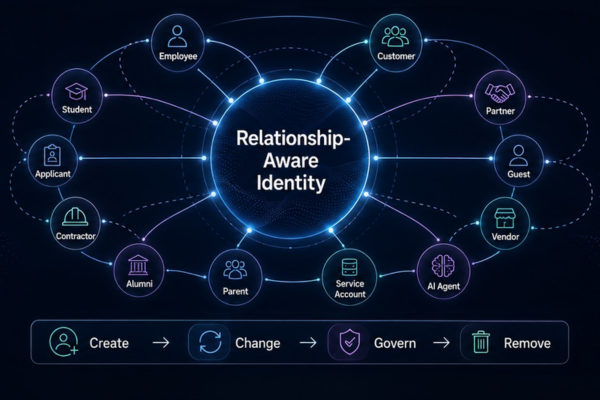
Today, organizations manage employees, contractors, vendors, partners, students, alumni, affiliates, service accounts, privileged accounts, robotic process automations, and now AI agents. Some identities are human. Some are non-human. Some are long-term. Some are temporary. Some are tied to a person. Some are tied to a business process. Some may operate across systems faster than any human user could.
At the same time, the methods used to attack identity have become more sophisticated. Help desks can be socially engineered. MFA reset processes can be targeted. Candidate screening can be manipulated. Synthetic identities can be created. Deepfake and AI-enabled impersonation can make weak verification processes look legitimate.
In that environment, organizations cannot rely on a one-time trust event. Verifying someone during onboarding is important, but it is not enough by itself. Trust has to be established, maintained, reviewed, and sometimes re-verified during sensitive moments across the identity lifecycle.
Identity Verification Needs to Happen at the Right Moments
A mature IAM program should apply identity verification where it matters most. That does not mean creating unnecessary friction for every user at every login. It means applying the right level of assurance at the right time, based on risk and business context.
The initial account claim process is one of the most important moments. When a person first claims an account, the organization should have strong confidence that the right person is taking control of the right digital identity. If the wrong person claims that account, every system connected to that identity may be exposed.
But account claim is only the beginning. Organizations should also consider stronger verification during high-risk lifecycle events such as password resets, MFA resets, account recovery, privileged access requests, sensitive application access, reactivation of dormant accounts, contractor onboarding, role changes, and other events where the risk of impersonation or inappropriate access is higher.
This is one of the areas where Fischer Identity can help organizations move from assumed trust to verified trust.
Fischer Identity supports identity verification as part of the broader IAM lifecycle, including initial account claim and other sensitive identity processes. Instead of treating IDV as a disconnected tool or a one-time onboarding step, Fischer Identity can help organizations embed verification into the identity journey itself. That means identity proofing can become part of how accounts are claimed, how access is restored, how high-risk changes are approved, and how trust is reinforced over time.
For organizations with regulatory, security, or audit requirements, this matters. It creates a stronger chain of trust from identity creation through access assignment, lifecycle changes, governance reviews, and eventual deprovisioning.
AI Agents Are Becoming Identities Too
The rise of AI agents adds another layer to this conversation. If an AI agent can retrieve data, trigger workflows, call APIs, interact with business systems, or act on behalf of a person or process, then it needs to be governed as an identity.
That does not mean AI agents are identical to human users. They are not. But from a control perspective, the organization still has to answer familiar identity questions.
Who or what owns this agent? What is it allowed to access? What actions can it perform? Was that access approved? Is it acting independently or on behalf of a human user? How is activity logged? How is access reviewed? When should that access expire? What happens if the business process changes or the agent is retired?
These are the same kinds of questions organizations already struggle with for service accounts, privileged accounts, integrations, and automation tools. AI simply raises the stakes because agentic systems may act faster, interact with more data, and operate across more systems than traditional human users.
That is why agentic trust cannot be based on hope. It has to be based on identity, governance, policy, visibility, and lifecycle control.
This Is Where Fischer Identity Brings Real Value
Fischer Identity has more than 20 years of experience helping complex organizations solve identity problems that go far beyond the login screen. Our work has always centered on a practical idea: identity should be verified, governed, automated, and auditable.
That experience matters because real-world identity environments are messy. A person may have more than one relationship with an organization. A student may become an employee. An employee may return as a contractor. A vendor may need temporary access. A privileged user may need additional oversight. A service account may support a critical process. An AI agent may eventually act on behalf of a department or workflow.
These are not edge cases anymore. They are normal operating conditions in complex organizations.
Fischer Identity helps bring structure to that complexity by connecting identity management, access management, lifecycle automation, identity verification, governance, and auditability into a broader identity operating model.
That includes helping organizations:
- Establish stronger trust during initial account claim.
- Apply identity verification during sensitive lifecycle events.
- Automate access when people join, move, or leave.
- Govern access across human and non-human identities.
- Support access reviews with clearer business context.
- Reduce stale accounts and excessive access.
- Improve audit readiness with better evidence.
- Connect identity assurance to real access decisions.
- Support Zero Trust strategies with a stronger identity foundation.
This is also why Fischer Identity’s history matters. Fischer Identity has long operated in the identity space and holds the trademarks for Identity as a Service® and IAAS®. Those trademarks are not just historical footnotes. They reflect the fact that Fischer Identity understood early that identity should be delivered as a strategic, integrated service, not treated as a collection of disconnected tools.
The same is true with Zero Trust. Long before Zero Trust became a common boardroom phrase, Fischer Identity was already aligned with the idea that trust should not be assumed simply because someone has a credential or sits inside a network. Trust should be based on identity, policy, verification, governance, and continuous control.
Identity Is Becoming Business Infrastructure
One of the most important shifts organizations need to make is how they think about IAM. It should not be viewed as only a security project or an authentication tool. Identity is business infrastructure.
It affects how quickly people can start working. It affects how safely contractors are onboarded. It affects how access is approved and removed. It affects how help desks validate users. It affects how auditors evaluate controls. It affects how cloud services, SaaS platforms, automation, and AI-driven workflows are adopted.
When identity is weak, the organization feels it everywhere. Users wait for access. Help desks absorb avoidable work. Managers approve access they do not fully understand. Security teams chase stale accounts. Auditors ask for evidence that is difficult to produce. Leadership lacks visibility into access risk.
When identity is strong, the organization moves with more confidence. Access becomes faster, cleaner, more consistent, and easier to prove.
That is the real value of mature IAM and IGA. It is not just about getting people into applications. It is about giving the organization a trusted way to manage digital relationships at scale.
The Next Frontier Is Verified Trust
The next frontier of identity is not just passwordless authentication. It is not just better MFA. It is not just another access tool.
The next frontier is verified trust.
That means verified people, verified account claims, verified recovery processes, verified access decisions, verified lifecycle changes, and eventually verified non-human actors such as service accounts, automations, and AI agents.
For some organizations, this will feel like a new challenge. For Fischer Identity, it is a natural extension of the work we have been doing for more than two decades.
The future of identity will require organizations to connect IAM, IGA, identity verification, lifecycle automation, access governance, and Zero Trust principles into one practical strategy. The organizations that do this well will be better prepared for workforce fraud, AI-enabled threats, regulatory expectations, cloud growth, and the continued rise of agentic systems.
The question every organization should be asking is simple:
Are we only verifying the login, or are we truly governing trust?