Artificial intelligence is changing the identity conversation quickly. AI agents, automated workflows, service accounts, API credentials, bots, scripts, and other non-human identities are expanding across enterprise environments at a pace most organizations did not design for.
That has led to a growing argument in the market: traditional Identity Governance and Administration (IGA) platforms cannot see or govern AI agents, so the category itself is no longer sufficient.
There is truth in the concern. There is also an important distinction that is being missed.
AI agents do expose weaknesses in legacy identity programs. They can be created inside applications, inherit permissions from users or systems, call tools, interact with data, and perform work without following the familiar joiner-mover-leaver pattern used for human employees. They may not submit an access request. They may not sit cleanly in an HR source. They may not exist long enough to wait for a quarterly access review.
But that does not make identity governance irrelevant.
It makes identity governance more important.
The Real Issue Is Not Whether IGA Matters
The real issue is whether the organization has a governance model capable of answering the right questions.
- Who owns the agent?
- Why does it exist?
- What business process does it support?
- What human, department, application, or system is accountable for it?
- What access does it have?
- What access did it inherit?
- Who approved that access?
- How long should that access remain active?
- Can the access be certified?
- Can it be disabled, suspended, expired, or removed?
- Can it be tied back to a responsible owner when something goes wrong?
These are not merely runtime security questions. These are identity governance questions.
Runtime monitoring, API security, SIEM, PAM, cloud security, application logging, and emerging AI security controls all have a role to play. They can help determine what an agent did, where it connected, what tools it called, and whether its behavior was risky.
But those tools do not replace the need for a system of record for ownership, accountability, lifecycle, policy, certification, and entitlement governance.
That is the role of IGA.
AI Agents Are Part of the Non-Human Identity Problem
AI agents are not the first non-human identity challenge organizations have faced. Enterprises have been dealing with service accounts, shared accounts, privileged accounts, application accounts, scripts, integrations, robotic process automation, and API credentials for years.
What has changed is the speed, autonomy, and visibility problem.
AI agents may act on behalf of a person, an application, a department, or another system. They may use inherited permissions. They may operate across SaaS platforms. They may initiate actions based on goals rather than fixed instructions. They may create or use credentials in ways traditional governance programs were not designed to track.
Recent industry research reflects this concern. Cloud Security Alliance research commissioned by Strata Identity found that only 18% of security leaders were highly confident that their IAM programs could manage AI agent identities. Sophos also reported that weak non-human identity management was a root cause in 41% of successful identity breaches.
Those numbers should get attention. But they should not lead organizations to the wrong conclusion.
The answer is not to abandon IGA. The answer is to modernize the governance model so non-human identities, including AI agents, are treated as first-class governed identities.
What Modern IGA Must Provide
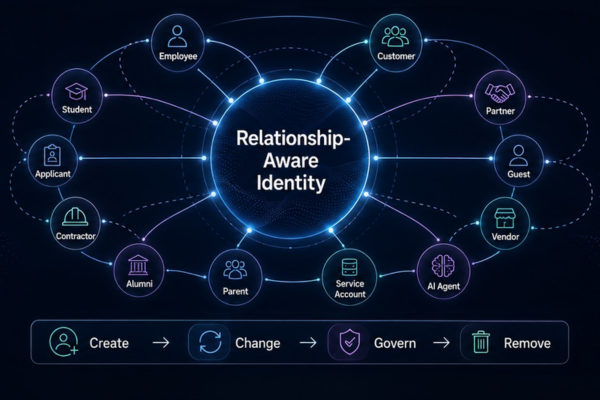
A modern identity governance platform must be able to govern more than employees. It must support the full reality of the enterprise identity population.
That includes employees, contractors, students, faculty, alumni, vendors, affiliates, partners, guests, administrators, service accounts, shared accounts, privileged accounts, application accounts, and increasingly, AI agents.
For AI agents and other non-human identities, governance should include:
- Ownership assignment.
- Business justification.
- Sponsorship.
- Lifecycle state.
- Access policy.
- Entitlement visibility.
- Approval workflow.
- Provisioning and deprovisioning.
- Expiration and renewal.
- Certification.
- Auditability.
- Association to a human owner, department, application, or business process.
This is where IGA remains essential. Organizations do not simply need to know that an agent made an API call. They need to know whether the agent should have existed, whether it was approved, who was accountable for it, what access it was allowed to use, and whether that access was still appropriate.
That is governance.
Fischer Identity’s View
Fischer Identity has long approached identity governance as more than a basic employee joiner-mover-leaver function.
Our platform is designed to support complex identity populations and complex lifecycle requirements across industries where identity is rarely simple. Higher education, healthcare, public sector, and enterprise environments often include multiple affiliations, multiple systems of record, sponsored users, non-standard populations, shared access models, and deeply embedded legacy systems.
That experience matters.
AI agents are not just another account type to discover after the fact. They need to be governed within a broader identity framework that can connect them to ownership, policy, access, lifecycle, and accountability.
Fischer Identity can help organizations establish that governance foundation by modeling non-human identities, assigning ownership, applying lifecycle controls, managing approvals, provisioning and deprovisioning access, supporting certification processes, and tying access back to responsible individuals, departments, systems, and business processes.
That is the practical path forward.
Periodic Certification Alone Is Not Enough
There is one point worth stating clearly: periodic certification by itself is not enough for AI agents.
If an agent can change behavior, use different tools, or operate across systems in near real time, then a quarterly or annual review will not capture the full risk. Organizations need runtime visibility and security telemetry from the systems where agent activity occurs.
But certification still matters.
Certification answers a different question. It confirms whether the access, ownership, purpose, and continued existence of the identity remain appropriate. It creates accountability. It documents review. It supports audit. It gives leadership evidence that non-human identities are not operating without oversight.
The future is not runtime security instead of IGA.
The future is runtime security connected to IGA.
Cost Matters
Many organizations know they need better identity governance but assume the only path forward is a seven-figure implementation with long timelines, heavy customization, and significant operational drag.
That does not have to be the case.
Fischer Identity has consistently delivered identity governance and administration capabilities at a much more practical cost point. A typical first-year Fischer Identity product and implementation effort can be very affordable, depending on scope and customer requirements.
That matters because AI agent and non-human identity governance cannot become another unfunded risk discussion. Organizations need a path they can actually execute.
The business case is straightforward: if non-human identities are expanding, if AI agents are being introduced into business processes, and if leadership expects identity dashboards to reflect real risk, then the governance layer must include these identities.
A green dashboard that excludes the fastest-growing identity category in the environment is not assurance. It is incomplete measurement.
The Right Conclusion
AI agents do not make IGA obsolete.
They expose whether an IGA program is flexible enough to govern the modern identity landscape.
Organizations should not think of AI agent governance as a separate problem disconnected from identity governance. They should treat it as the next evolution of identity governance.
Fischer Identity is built for that kind of practical, integrated governance. We believe organizations should not have to choose between doing this correctly and doing it affordably.
The future of identity governance is not limited to people.
It must govern every identity that can access data, perform work, trigger transactions, or create risk.
That includes AI agents.
And it starts with a governance platform that understands ownership, accountability, lifecycle, policy, certification, and access from the beginning. Fischer Identity