Healthcare identity management is different.
I have said that many times throughout my career, but the more I work with complex identity environments, the more strongly I believe it. Healthcare does not have the luxury of treating Identity and Access Management as a slow-moving back-office process. Access delays in healthcare are not just frustrating. They can impact clinical operations, patient care, compliance, and the ability of doctors and nurses to do the work they were brought in to do.
One area where this becomes very real is the onboarding and governance of traveling healthcare professionals. Around 90% of all US Healthcare facilities rely on locum providers to maintain coverage.
Traveling nurses, traveling physicians, temporary clinicians, locum tenens providers, contract healthcare workers, and supplemental clinical staff play an important role in modern healthcare operations. Hospitals and healthcare systems rely on them to fill staffing gaps, support patient volumes, respond to seasonal demand, cover vacancies, and maintain continuity of care.
But from an identity governance perspective, these populations are complicated.
They may not be employees of the healthcare organization. They may work for a staffing agency, a contracted partner, or another third-party organization. They may only be assigned to the hospital for a short period of time. Their arrival may be known weeks in advance, or it may be communicated at the last minute. The business may view the onboarding process as simple: “A nurse is starting Monday.” But from an IAM and IGA perspective, that sentence carries a lot of operational, technical, and security complexity.
And if that complexity is not handled properly, the result is predictable: the clinician arrives, reports to the floor, and cannot access the systems needed to do the job.
That should never happen.
The Healthcare Access Problem No One Wants to Own
In many healthcare organizations, the onboarding of traveling clinicians starts as a staffing problem, not an identity problem.
A department needs coverage. A staffing agency provides a name. Credentialing, HR, nursing administration, medical staff services, IT, security, and application teams may all play some role in the process. But unless the organization has a mature identity governance model, the handoff between these groups is often inconsistent.
The business may not understand what IT needs to create and govern the identity. IT may not receive enough source data to perform accurate identity matching. The IAM team may not know whether this individual previously worked at the organization under another role. The EHR team may not get the necessary information until the clinician is already close to starting. The service desk may receive an urgent ticket that says, “This person needs access immediately.”
That is not a scalable identity strategy. That is an operational scramble.
Healthcare organizations cannot afford to manage access to clinical systems through last-minute emails, spreadsheets, hallway conversations, and emergency tickets. It creates delays, increases support burden, weakens governance, and raises the likelihood of access being granted too broadly just to get someone working.
Identity governance must be treated as part of the clinical onboarding process, not as a technical afterthought.
Why Traveling Doctors and Nurses Are So Difficult to Govern
Traveling healthcare professionals create a unique identity challenge because they often sit outside the clean, structured workforce model that many IAM programs were designed around.
Traditional employee onboarding usually has a defined source of authority, such as an HR system. The employee is hired, the HR record is created, required attributes are populated, and IAM can trigger downstream provisioning. That model is not perfect, but at least the source system is usually understood.
Traveling clinicians are different.
Their “true” source may be a staffing agency or contracting company. Their relationship to the healthcare organization may be temporary. The healthcare organization may not want or need to expose that distinction to patients, because operationally these professionals need to function as part of the care team. But the identity system still has to know the difference.
From an IAM perspective, a traveling nurse cannot simply be treated exactly like a full-time employee unless the business rules support that. A locum physician may need EHR access, clinical application access, badge access, network access, and possibly remote access, but only for the duration of the assignment. A traveling nurse may need access tied to a unit, facility, department, shift, manager, or care setting. A clinician moving between facilities may require access to one hospital this week and another next week.
That means the identity platform must understand more than a name and start date.
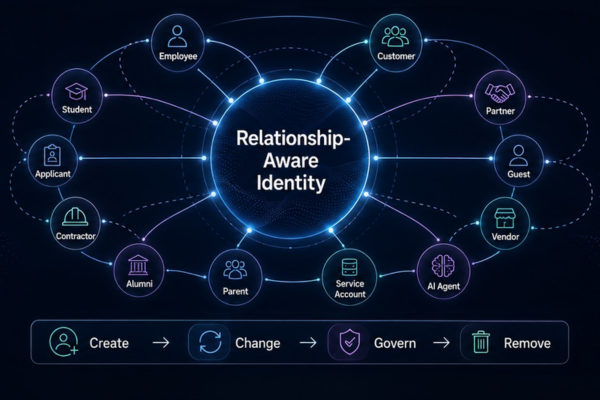
It needs to understand affiliation, assignment, location, role, clinical function, sponsor, start date, end date, credentialing status, access requirements, and whether the individual already exists in the enterprise identity record.
That last point matters more than many organizations realize.
Identity Matching Is Not Optional in Healthcare
One of the biggest risks with traveling clinicians is duplicate identity creation.
A traveling nurse may have worked for the organization two years ago through a different agency. A physician may have previously been a resident, fellow, contractor, faculty member, or affiliated provider. A clinician may return under a new assignment, a new name, a different email address, or a different staffing source.
If the organization does not have strong identity matching, that person can easily become two or three different digital identities across HR, directories, EHR, badge systems, and downstream applications.
That creates several problems.
First, it creates access confusion. Which account is active? Which one has the right EHR profile? Which account should be disabled when the assignment ends?
Second, it creates security risk. Duplicate accounts can become orphaned accounts. Orphaned accounts can become unmanaged access. Unmanaged access is exactly the kind of thing that shows up during audits, incident response, or breach investigations.
Third, it creates operational friction. The user may not know which credentials to use. The service desk may reset the wrong account. Application owners may provision access to the duplicate account because that is the one in the ticket.
In healthcare, identity matching is not a nice-to-have. It is foundational. If the identity record is wrong, everything downstream becomes questionable.
Limited Source Data Creates Real Risk
Here is the uncomfortable truth: many business teams do not know what identity data is required to safely and accurately onboard a traveling clinician.
That is not a criticism. It is simply reality.
A staffing coordinator may think they are doing everything needed when they provide a name, email address, role, and start date. But for identity governance, that may not be enough. The IAM team may need date of birth, personal email, phone number, agency identifier, license or credentialing reference, assigned department, facility, manager, sponsor, end date, and other attributes depending on the organization’s matching and provisioning requirements.
Without sufficient data, the organization is forced into bad choices.
It can delay access while someone hunts for missing information. It can manually create an account with weak matching confidence. It can over-provision access because the exact access model is unclear. Or it can push the issue to the service desk and hope someone figures it out.
None of those options are good.
The answer is not to blame the business. The answer is to build a better process.
This is where experienced IAM leadership matters. IT and security leaders need to sit with clinical operations, HR, credentialing, medical staff services, nursing administration, staffing teams, and application owners to define the identity process in business terms. What data is required? Who owns it? When must it be available? What is the trigger for access? What happens when the assignment changes? What happens when the assignment ends early? What is the emergency access process? What access is temporary, and what must be certified?
These are business process questions before they are technical questions.
Access to the EHR Is a Patient Care Issue
For traveling clinicians, access to the Electronic Health Record is usually the most visible and time-sensitive access need.
A doctor or nurse who cannot access the EHR cannot fully perform the work expected of them. They may be unable to review patient history, document care, place orders, administer medication workflows, validate clinical information, or coordinate with the broader care team depending on their role.
This is where identity governance moves from theory to reality.
A clinician standing on a hospital floor without access to required systems is not just an IT inconvenience. It impacts standards of care. It creates frustration for the clinician, the unit, the patient care team, and the leaders who expected that person to be productive when they arrived.
At the same time, healthcare organizations cannot simply grant broad access to avoid delays. Access must be appropriate, policy-driven, auditable, and removed when no longer needed.
That is the balance healthcare IAM must achieve: fast access, correct access, and governed access.
The Right Process Starts Before the Clinician Arrives
A mature process for traveling healthcare professionals should begin before day one.
The staffing or credentialing workflow should trigger an identity event as soon as the assignment is approved or reaches the appropriate business milestone. The identity platform should receive the necessary attributes, match the individual against existing identities, determine whether a new identity is needed, apply the correct role and policy logic, and provision access to the appropriate systems.
That may include Active Directory, LDAP, Oracle Health / Cerner, Epic-related access workflows, email, clinical applications, badge systems, learning management systems, ServiceNow, remote access tools, and other healthcare platforms.
The exact systems vary by organization, but the principle is the same.
Access should be driven by verified identity data and business rules, not by last-minute manual tickets.
The process should also account for assignment end dates. Traveling clinicians should not retain access indefinitely because no one remembered to remove them. Deprovisioning should be part of the original lifecycle plan. If the assignment is extended, access should be extended through an approved process. If the assignment ends early, access should be removed based on policy.
This is identity governance. It is not just provisioning. It is the full lifecycle.
Why Fischer Identity Is Built for This Type of Healthcare Complexity
Fischer Identity is well suited for this problem because we understand that IAM and IGA are not just technology disciplines. They are business process disciplines.
We help organizations identify the real source data required to make identity processes work. We work with IT leaders and business stakeholders to define how identity data should flow, what attributes are needed, how users should be matched, how access should be assigned, and how lifecycle changes should be governed.
For traveling doctors and nurses, this matters.
Fischer Identity can help healthcare organizations build policy-driven onboarding workflows that account for temporary clinical assignments, third-party staffing relationships, contract-based access, role-based and attribute-based access decisions, and timely deprovisioning. Instead of relying on manual processes and disconnected handoffs, organizations can automate the lifecycle in a way that supports clinical operations and security.
Fischer Identity also brings strong identity matching capabilities. That is critical when a traveling clinician may have previously existed in the environment under another role, another source, or another relationship to the organization. By preventing unnecessary duplicate identities, organizations improve security, reduce confusion, and create cleaner audit trails.
And for healthcare organizations using Oracle Health, formerly Cerner, Fischer Identity provides a native Oracle Health connector that supports identity and provisioning integration with Oracle Health Millennium environments. That is not a small point. EHR access is one of the most important identity use cases in healthcare, and organizations need IAM platforms that can connect clinical access needs to enterprise identity lifecycle processes.
Healthcare Needs More Than Basic IAM
Many healthcare organizations already have pieces of IAM.
They may have SSO. They may have MFA. They may have directory services. They may have ticketing workflows. They may have some form of access review. Those tools matter, but they do not automatically create a mature identity governance program.
The harder challenge is lifecycle orchestration.
- Who is this person?
- Why are they here?
- Who authorized the relationship?
- What role are they performing?
- What systems do they need?
- When should access begin?
- When should access end?
- What happens if their assignment changes?
- Has this person been here before?
- Can we prove access was appropriate?
Those are the questions that matter in healthcare identity governance.
Traveling clinicians expose the weakness of disconnected identity processes because their lifecycle is compressed, urgent, and often dependent on incomplete data. If the process is weak, the failure becomes visible very quickly.
The Goal Is Simple: No Clinician Waiting for Access
The goal should be simple.
When a traveling nurse reports to the unit, access should be ready.
When a locum physician begins coverage, the right clinical systems should be available.
When the assignment ends, access should be removed.
When the clinician returns six months later, the organization should recognize the person and govern the new assignment correctly.
That is what good healthcare identity governance looks like.
It is not about making identity more complicated. It is about removing friction from clinical operations while strengthening security and compliance.
Final Thought
Traveling doctors and nurses are essential to modern healthcare delivery. They help organizations meet staffing needs, maintain patient care coverage, and respond to changing clinical demand. But their identity lifecycle cannot be treated as an exception every time they arrive.
If every temporary clinician becomes a fire drill, the process is broken.
Healthcare organizations need identity governance that understands the business reality of clinical staffing. They need accurate source data, strong identity matching, automated lifecycle workflows, EHR-aware provisioning, timely deprovisioning, and clear ownership across the business and IT.
Fischer Identity helps healthcare organizations build that foundation.
Because in healthcare, the right access at the right time is not just an IAM principle. It is part of delivering care.