Identity Governance Has Entered a New Era
At Identiverse last week, one topic kept coming up in session after session, hallway conversation after hallway conversation: how do organizations govern AI agents and non-human identities?
It is a fair question, and it is becoming urgent.
For years, organizations have managed identities around a familiar model: a person joins the organization, receives access, changes roles, and eventually leaves. Identity Governance and Administration, or IGA, was built around that lifecycle. The employee, student, contractor, vendor, or partner was the center of the identity record. In many products, this data was static or only updated at some frequency.
But the enterprise identity landscape has changed.
Today, access is not limited to people. Organizations now rely on service accounts, application accounts, API keys, OAuth grants, service principals, robotic process automation accounts, machine credentials, cloud workloads, and increasingly, AI agents.
These non-human identities, often called NHIs, are not side issues anymore. They are now part of the operational fabric of the modern enterprise. They connect systems, execute workflows, retrieve data, trigger processes, and in the case of AI agents, may even make decisions or take actions on behalf of a person or business process.
That creates a critical identity governance question:
Who owns the non-human identity, and what happens to it when that owner changes roles or leaves the organization?
That question sounds simple. It is not.
And for many organizations, it is exactly where the risk begins.
What Are Non-Human Identities?
A non-human identity is any digital identity that is not directly used by a person but still has access to systems, data, applications, or services.
Common examples include:
- Service accounts
- Application accounts
- API keys
- OAuth grants
- Service principals
- Automation accounts
- Robotic process automation bots
- Cloud workload identities
- Integration accounts
- Database connection accounts
- AI agents
- AI assistants connected to enterprise systems
These identities often exist because business needs them. They are not inherently bad. In fact, most modern organizations cannot operate without them.
The problem is not that non-human identities exist.
The problem is that many of them are created outside of strong identity governance processes, assigned excessive access, rarely reviewed, and not clearly tied back to a responsible human owner.
That is where organizations get exposed.
AI Agents Raise the Stakes
Traditional service accounts were already difficult enough to manage. AI agents make the problem more complex.
A business user may create an AI agent to help summarize documents, generate reports, analyze customer information, process support tickets, or automate a workflow. That agent may then be granted access to systems such as Microsoft 365, Salesforce, ServiceNow, Workday, Google Workspace, a data warehouse, or other business applications.
From a business perspective, this feels fast and productive.
From an identity governance perspective, it can become dangerous very quickly.
An AI agent may inherit or receive access based on the person who created it. It may connect to downstream systems. It may use OAuth grants, API connections, service principals, or other credentials. It may continue operating after the employee who created it has changed roles or left the organization.
That creates a chain of access that may no longer have a clear owner.
- The employee leaves.
- The AI agent remains.
- The credentials remain.
- The access remains.
- The risk remains.
This is how orphaned AI accounts and unmanaged non-human identities become long-term security gaps.
The Real Risk Is Access Without Accountability
When organizations talk about AI security, the conversation often starts with data leakage, prompt injection, hallucinations, or improper use of generative AI tools. Those are real concerns.
But there is another risk sitting directly inside the identity program:
AI agents and non-human identities often have access without clear accountability.
That means an organization may not be able to answer basic questions such as:
- Who owns this AI agent?
- Who approved its access?
- What systems can it reach?
- When was the access last reviewed?
- What happens if the owner leaves?
- Should ownership transfer to the manager?
- Should the AI agent be disabled?
- Should the related API keys, OAuth grants, or service principals be revoked?
If these questions cannot be answered quickly, the organization does not have true identity governance over that account.
It has hope.
Hope is not a security control.
Why Traditional IAM and IGA Approaches Often Fall Short
Many IAM and IGA programs were built around human lifecycle events. A person is hired, moved, terminated, retired, or converted from one role to another. Access is granted or removed based on that status.
That model still matters, but it is no longer enough by itself.
Non-human identities require a different level of relationship mapping. They must be connected to:
- A responsible human owner
- A manager or sponsor
- A department or business unit
- A system or application
- A purpose
- An expiration or review schedule
- A risk level
- A lifecycle policy
- A recertification process
- A deprovisioning rule
Without these relationships, an AI agent or service account becomes a disconnected technical object. It may exist in a target system, but it is not governed as part of the organization’s identity lifecycle.
That is the gap.
An identity governance platform must be able to manage more than people. It must manage relationships between people, business processes, systems, and non-human accounts.
Fischer Identity Has Been Solving This Type of Problem for Years
This is where Fischer Identity’s approach matters.
For more than 20 years, Fischer Identity has helped organizations manage complex identity populations that do not fit neatly into a standard employee-only model. Higher education, healthcare, government, finance, and other complex environments have always required more than basic user provisioning.
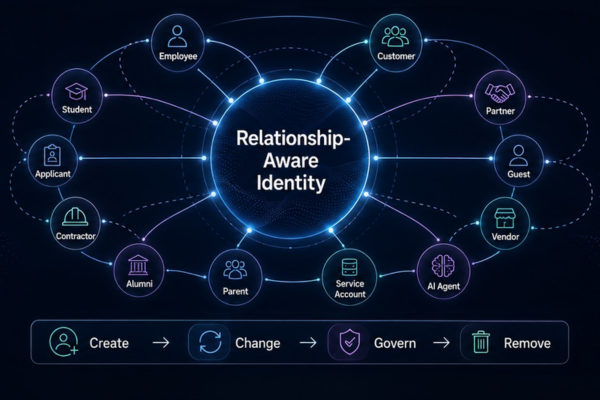
Organizations have had to manage employees, students, faculty, alumni, retirees, contractors, vendors, volunteers, visiting scholars, board members, guests, service accounts, shared responsibility accounts, and external users.
The names change.
The governance problem is familiar.
Who owns the account?
What access should it have?
When should access change?
Who reviews it?
What happens when the responsible person leaves?
Fischer Identity has long supported the ability to link non-traditional accounts back to a responsible person, sponsor, manager, or business owner. That same lifecycle model applies directly to non-human identities and AI agent accounts.
Rather than treating an AI agent as an isolated object, Fischer Identity can manage it as part of the broader identity lifecycle.
How Fischer Identity Manages AI Agents and NHI Accounts
Fischer Identity allows organizations to apply real identity governance to non-human identities, including AI agents, service accounts, automation accounts, and other machine-based identities.
This can include:
1. Linking the AI or NHI Account to a Responsible Human Owner
The first step is ownership.
An AI agent, service account, or application identity should be tied to a responsible employee, sponsor, manager, or business unit. This creates accountability and ensures the account is not floating freely inside the environment.
This ownership model allows the organization to know who is responsible for the account, who should review access, and who should be contacted when something changes.
2. Applying Lifecycle Policies
Once ownership is established, Fischer Identity can apply lifecycle policies to the AI or NHI account.
For example:
- If the owner changes departments, trigger an access review.
- If the owner transfers to a new role, validate whether the AI agent is still needed.
- If the owner leaves the organization, route the account to the manager for review.
- If no new owner is assigned, disable or deprovision the account.
- If the account reaches an expiration date, suspend access pending recertification.
- If the account is high risk, require more frequent access reviews.
This is where identity lifecycle management becomes practical security.
3. Escalating Ownership Through the Org Chart
In many cases, immediate deprovisioning may not be the right answer.
An AI agent may support an active business process. A service account may be tied to a production integration. A workflow automation account may still be needed after the original employee leaves.
Fischer Identity can support policy-driven ownership escalation. Instead of letting the account remain orphaned, the system can route responsibility to the employee’s manager or another defined sponsor.
The manager can then certify the account, assign a new owner, change access, or request deprovisioning.
This prevents unmanaged access while protecting business continuity.
4. Automating Recertification and Access Reviews
AI agents and non-human identities should not be exempt from access reviews. In many cases, they should be reviewed more carefully than human accounts because they often operate quietly in the background.
Fischer Identity can support automated recertification processes for these accounts.
Reviewers can be asked to confirm:
- Is this AI agent or NHI account still needed?
- Is the listed owner still correct?
- Is the access still appropriate?
- Should any entitlements be removed?
- Should the account be disabled?
This gives the organization an auditable process instead of an informal cleanup effort.
5. Deprovisioning Orphaned AI and NHI Accounts
The most dangerous non-human identity is often the one nobody owns.
When a human owner leaves and no valid sponsor accepts responsibility, Fischer Identity can enforce policy-based deprovisioning. That may include disabling the AI agent account, removing application access, revoking group memberships, disabling related service accounts, or triggering downstream workflows to remove credentials in connected systems.
The key point is simple: access should not live forever because nobody knows who owns it.
6. Supporting Policy-Based Access Control
AI agents and non-human identities should be governed by policy, not guesswork.
Fischer Identity supports policy-based access control models that can use identity attributes, ownership, department, risk level, account type, system, role, affiliation, and lifecycle state to determine what should happen.
This allows organizations to define different controls for different types of non-human identities.
For example:
- A low-risk reporting bot may require annual review.
- A privileged service account may require quarterly certification.
- An AI agent with access to sensitive data may require manager approval and shorter expiration windows.
- A production integration account may require dual ownership or escalation rules.
- An external vendor automation account may require a defined end date.
One policy does not fit every identity type. Fischer Identity gives organizations the flexibility to govern based on risk and business need.
A Practical Example
Consider a business user who creates an AI agent, in Fischer Identity, to help process support tickets. The agent is connected to ServiceNow, Microsoft 365, and a customer data repository. It has access to read tickets, summarize content, retrieve user information, and generate response recommendations.
Initially, this may be legitimate.
But six months later, the employee transfers to another department.
What happens to the AI agent?
In a weak governance model, nothing happens. The agent keeps running. Its access remains active. No one reviews it. No one owns it. No one notices.
In a Fischer Identity governance model, the employee’s role change can trigger policy.
The AI agent can be flagged for review. Ownership can be routed to the employee’s manager. The manager can confirm whether the agent is still needed, transfer ownership, reduce access, or deprovision the account.
If the employee leaves the organization, Fischer Identity can again apply policy. The account can be escalated, recertified, reassigned, disabled, or fully deprovisioned depending on the organization’s rules.
That is the difference between unmanaged access and governed identity.
AI Agents Are Digital Workers, But They Still Need Human Accountability
There is a growing phrase in the industry that AI agents are becoming digital workers.
That is a useful concept, but it should not be misunderstood.
AI agents may perform work, but they are not employees. They do not have personal accountability. They do not sit in HR. They do not appear in a traditional employee lifecycle. They do not resign, retire, or get terminated in the same way a person does.
That is why they must be tied to a responsible human, sponsor, manager, or business process.
Every AI agent should have an accountable owner.
Every non-human identity should have a lifecycle.
Every service account should have a review process.
Every API credential should have a purpose.
Every OAuth grant should be visible.
Every machine identity should be governed.
Without that, organizations are building automation on top of unmanaged risk.
Questions Organizations Should Ask Their IAM and IGA Vendors
As AI agents and non-human identities become more common, organizations should ask direct questions of their IAM and IGA vendors.
Can your platform:
- Link an AI agent or non-human identity to a responsible employee?
- Trigger a review when the owner changes roles?
- Escalate ownership when the owner leaves?
- Transfer ownership through the org chart?
- Deprovision the AI or NHI account when policy requires it?
- Certify access for service accounts, API accounts, and automation accounts?
- Apply different lifecycle rules by account type?
- Manage expiration dates and renewal workflows?
- Support policy-based access control for non-human identities?
- Provide audit history showing who owned the account and who approved access?
- Govern these accounts without custom code or unsupported scripts?
If the answer is no, the organization has a gap.
And that gap will only grow as AI adoption accelerates.
Why This Matters for Security, Compliance, and Audit
Non-human identity governance is not just an IAM issue. It affects security, compliance, audit, operations, and risk management.
Poor NHI governance can lead to:
- Orphaned service accounts
- Excessive privileges
- Unreviewed AI agent access
- Persistent OAuth grants
- Long-lived credentials
- Unclear accountability
- Failed access reviews
- Audit findings
- Data exposure
- Privilege creep
- Shadow AI risk
- Manual cleanup efforts
- Inconsistent deprovisioning
These are not theoretical risks. They are the natural result of access that is not tied to lifecycle, ownership, and policy.
Modern identity governance must answer not only “who has access,” but also “what has access, why does it have access, who owns it, and when should that access end?”
Fischer Identity: Built for Complex Identity Governance
Fischer Identity has always focused on complex identity environments.
We are not the loudest company in the IAM and IGA market, and we do not try to win attention through oversized marketing campaigns. Our focus has been different: invest in the product, solve difficult identity problems, and support customers whose environments do not fit into simple templates.
That approach matters in the age of AI.
AI agents and non-human identities are not simple. They require flexible lifecycle management, advanced identity matching, policy-based governance, ownership mapping, access reviews, and automated deprovisioning.
Fischer Identity provides:
- Identity lifecycle management
- AI agent identity governance
- Non-human identity management
- Service account ownership tracking
- Simplified onboarding
- Automated provisioning and deprovisioning
- Access recertification
- Signal Ingestion
- Sponsor and manager-based reviews
- Complex Identity matching and reconciliation
- Full Hybrid cloud and on-premise integration
- No custom code
- Support for highly complex business rules and policies
- Governance across human, external, and non-human identities
- Continuous Identity Management
This is not a future roadmap concept.
This is the type of identity governance Fischer Identity has been built to support for years.
The Future of IAM Is Human, Non-Human, and AI
The future of identity governance will not be limited to workforce identity.
Organizations must govern human identities, external identities, non-human identities, and AI agent identities together. These identities are connected. Their access is connected. Their risk is connected.
- An employee may create an AI agent.
- That AI agent may connect to business applications.
- Those applications may use service accounts.
- Those service accounts may rely on API keys.
- Those credentials may persist long after the original employee has left.
That chain must be visible.
- It must be governed.
- It must have ownership.
- It must have lifecycle.
- It must have policy.
Fischer Identity helps organizations bring that chain under control.
Final Thought
AI agents will continue to grow across the enterprise. Business users will continue to adopt low-code and no-code tools. Automation will continue to expand. Non-human identities will continue to multiply.
Organizations cannot afford to manage this new identity landscape with manual spreadsheets, disconnected reviews, and hope.
The right approach is to bring AI agents and non-human identities into the same disciplined IAM and IGA framework used to manage people, roles, access, lifecycle, compliance, and risk.
Fischer Identity is ready for that challenge because we have been solving complex identity governance problems for more than two decades.
The identity world may be changing quickly.
The fundamentals still matter.
- Ownership matters.
- Lifecycle matters.
- Access reviews matter.
- Deprovisioning matters.
- Accountability matters.
And in the age of AI, they matter more than ever.
Is your organization prepared to manage AI agents, service accounts, and non-human identities with the same governance discipline you apply to employees?
Fischer Identity can help you bring AI agent identity governance and non-human identity lifecycle management under control.
Contact Fischer Identity to learn how our IAM and IGA platform can help your organization govern human, external, and non-human identities through policy, automation, ownership, and accountability.