Identity Verification Should Be Built Into the Identity Lifecycle, Not Added as a Separate Project
Identity verification is receiving increased attention across higher education, healthcare, research, government, and other complex organizations. That attention is warranted.
Institutions must be able to establish that a person is who they claim to be before issuing credentials, granting access to sensitive systems, providing remote support, or allowing recovery of a compromised account.
However, the industry conversation often frames identity verification as a separate initiative. Organizations are encouraged to attend workshops, participate in accelerator programs, engage consultants, evaluate point solutions, and then determine how identity verification might eventually connect to their existing Identity and Access Management environment.
Education and planning have value. But organizations should also ask a more practical question: Why is identity verification not already integrated into the identity platform responsible for managing the person’s complete digital lifecycle?
At Fischer Identity, identity verification is not treated as an isolated transaction or a separate technology project. It is built into the broader IAM and IGA platform and can be applied wherever an organization needs greater confidence in a person’s identity.
That distinction matters.
Identity Verification Is More Than a Student Onboarding Process
Identity verification is commonly discussed through a limited number of use cases:
- Verifying a student before issuing institutional credentials
- Supporting step-up authentication for a sensitive transaction
- Validating identity before issuing an institutional identification card
- Re-credentialing a user through the helpdesk
These are important use cases, but they represent only part of the opportunity.
The same verified identity can support a much broader set of business and security processes, including:
- Initial account claim
- Remote onboarding
- Credential issuance
- Multi-factor authentication enrollment
- Passwordless authentication
- Single sign-on
- Account recovery
- Password reset
- Helpdesk caller validation
- ID card or badge issuance
- Re-credentialing following suspected compromise
- Higher-assurance access to sensitive applications
- Verification of external users, contractors, researchers, and affiliates
These processes should not operate as separate identity events with different tools, disconnected records, or inconsistent verification standards.
They should be connected to one governed identity lifecycle.
Understanding Identity Proofing and Authentication Assurance
Identity proofing and authentication are closely related, but they are not the same function.
The current NIST SP 800-63-4 Digital Identity Guidelines distinguish among three assurance areas:
- Identity Assurance Level, or IAL, which addresses the strength of the identity proofing process
- Authentication Assurance Level, or AAL, which addresses the strength of the authentication process and the binding between an authenticator and an individual
- Federation Assurance Level, or FAL, which addresses the strength of federated identity assertions
NIST describes IAL as the robustness of the process used to determine an individual’s real-world identity, while AAL addresses the confidence provided when that individual later authenticates.
This distinction is important because verifying a person once does not automatically solve every authentication challenge. Likewise, deploying MFA does not prove that the person who enrolled the authenticator was the correct individual in the first place.
A mature identity program must connect the two.
The organization first establishes confidence in the person’s identity. It then securely binds credentials and authenticators to that verified identity and governs those credentials throughout the lifecycle.
Identity Verification Should Begin Before Credentials Are Issued
Many organizations still create accounts and issue usernames before they have adequately verified the person receiving them.
That approach creates unnecessary risk.
A more secure process begins with authoritative source data from systems such as:
- Human Capital Management platforms
- Student Information Systems
- Applicant or admissions platforms
- Contractor and vendor systems
- Customer Relationship Management platforms
- Research administration systems
- External identity sponsorship processes
Once a qualifying identity event occurs, Fischer Identity can initiate a configurable account claim and onboarding process.
Depending on the organization’s requirements, the user may be asked to provide or validate information such as:
- A unique account claim code
- Legal name
- Date of birth
- Personal contact information
- Government-issued identity evidence
- Biometric or facial verification
- Data matched against authoritative or credible sources
- Additional organization-defined identity attributes
Only after the required identity verification steps have been completed does the organization need to issue usable credentials or bind authenticators.
This allows identity proofing to occur before the individual gains access to institutional systems.
NIST SP 800-63A defines requirements for identity proofing and enrollment, including both remote and in-person models. It also establishes stronger evidence, validation, and verification expectations at IAL2 than at IAL1.
Fischer Identity supports configurable account claim and identity-proofing processes designed to align with an organization’s selected assurance requirements and business risks. Fischer’s account claim capabilities can incorporate HR or student data, unique codes, document checks, and other verification methods as part of a unified onboarding workflow.
One Verified Identity, Multiple Trusted Outcomes
The real value of an integrated approach appears after the initial proofing event.
Once an organization has established a trusted relationship between a real person and a digital identity, that trusted foundation can support additional identity processes.
Account Claim and Initial Onboarding
The user can securely claim their institutional identity before receiving access to protected resources.
The workflow can also include:
- Password creation
- MFA enrollment
- Recovery email and telephone registration
- Acceptance of organizational policies
- Preferred name selection
- Security notification preferences
- Role-specific onboarding instructions
Fischer Identity’s account claim model is designed as a configurable part of onboarding rather than a detached verification service. (fischeridentity.com)
Student Identity Proofing
Students increasingly interact with institutions remotely, often long before arriving on campus.
Waiting for an in-person visit to establish credentials creates delays, support demand, and a poor student experience. A secure remote identity-proofing process can allow admitted students to obtain credentials earlier and gain timely access to:
- Student portals
- Housing systems
- Financial aid information
- Orientation materials
- Learning platforms
- Email
- Registration services
At the University of Virginia, Fischer Identity’s Identity Claim process allowed students and employees to obtain credentials without relying on the previous in-person credentialing model. This reduced logistical burdens and helped users gain access earlier in their institutional relationship.
MFA and Passwordless Enrollment
A person should not simply register a strong authenticator. The institution should have confidence that the authenticator is being registered by the correct person.
An integrated identity-verification process can establish that confidence before binding:
- Mobile authenticators
- Hardware security keys
- FIDO2 or WebAuthn credentials
- Biometric authenticators
- Other passwordless methods
NIST defines AAL requirements around the strength of authentication and the binding between an authenticator and an individual’s identifier.
This makes identity proofing and authenticator enrollment natural parts of the same governed process.
Step-Up Authentication and Authorization
Some transactions require more confidence than a routine login.
Examples include:
- Viewing sensitive personal records
- Changing payroll or banking information
- Accessing regulated research data
- Approving financial transactions
- Modifying privileged access
- Issuing or resetting high-value credentials
In these cases, the identity platform can require additional verification or stronger authentication before permitting the action.
Fischer Identity supports adaptive authentication patterns that can introduce additional controls for higher-risk activity.
The broader objective is not merely to confirm that someone has a valid session. It is to evaluate whether sufficient identity and authentication assurance exists for the transaction being attempted.
ID Card and Badge Issuance
Physical credentials should be linked to the same governed identity used for digital access.
An institution should not have one identity process for IT credentials and another unrelated process for physical identification.
An integrated workflow can ensure that:
- The person has been appropriately verified
- The identity record is authoritative
- The correct affiliation and role are known
- Card eligibility policies are satisfied
- Issuance is recorded and auditable
- Expiration and revocation follow lifecycle events
This creates consistency across both digital and physical access.
Helpdesk Caller Validation
Helpdesk personnel are frequently asked to perform sensitive tasks based on a telephone call or support request.
These tasks may include:
- Resetting a password
- Re-enrolling MFA
- Changing a recovery telephone number
- Updating a personal email address
- Unlocking an account
- Reissuing credentials
Knowledge-based questions and easily discoverable personal information are not sufficient for high-risk support activity.
A better approach allows the helpdesk to trigger an identity-verification workflow through the same platform that manages the user’s identity.
This reduces social-engineering risk while giving support personnel a consistent and auditable method for validating the caller.
Password Reset and Account Recovery
Account recovery is often one of the weakest points in an authentication program.
An organization may deploy strong MFA or passwordless authentication but undermine it with a weak recovery process.
An integrated identity-verification service can apply appropriate assurance before allowing a user to:
- Reset a forgotten password
- Replace a lost authenticator
- Register a new device
- Recover an inaccessible account
- Change recovery information
- Restore access after suspected compromise
The required level of verification can be adjusted according to the sensitivity of the account, the requested action, and the organization’s risk model.
Identity Verification Must Follow the Person Across Roles
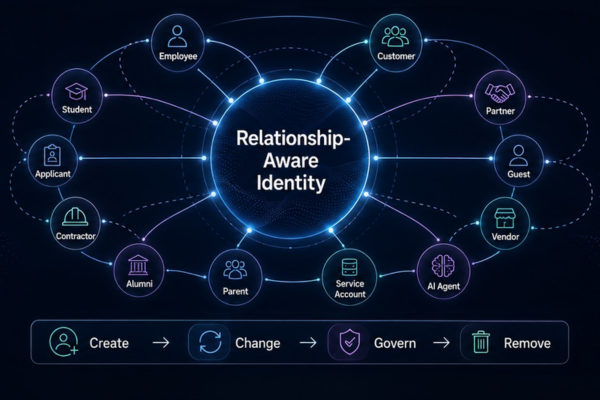
Identity lifecycles are rarely linear, particularly in higher education and healthcare.
A person may be:
- An applicant
- A student
- A student employee
- A research assistant
- A graduate
- An alumnus
- A contractor
- A volunteer
- A visiting scholar
- A faculty member
- A patient-facing clinician
- A returning employee
Some of these roles may occur sequentially. Others may exist at the same time.
The identity platform must understand that these are relationships connected to one person, not unrelated accounts that happen to have similar names.
This is why identity matching, lifecycle governance, and identity verification must operate together.
Fischer Identity supports complex, multi-role populations and can correlate identity data across multiple authoritative systems. Its lifecycle model allows access, policies, credentials, and verification requirements to evolve as the person’s relationship with the organization changes.
Identity verification should strengthen that unified identity record, not create another disconnected identity silo.
Verification Is Not a One-Time Event
A common mistake is to view identity proofing as something completed once and then permanently trusted.
In reality, confidence may need to be re-established when:
- A user returns after a long absence
- An account shows signs of compromise
- A credential has been lost or stolen
- The person requests privileged access
- A high-risk profile attribute changes
- A new authenticator is enrolled
- An institutional ID card is reissued
- The person moves into a regulated or sensitive role
- Existing identity evidence expires or becomes unreliable
An integrated identity platform can apply verification at appropriate points throughout the lifecycle.
This does not mean repeatedly inconveniencing every user. It means using policy and risk to determine when additional assurance is necessary.
The Problem With Treating Identity Verification as a Point Solution
A standalone identity-verification product may successfully verify a person. But verification alone does not manage what happens next.
Organizations must still determine:
- How the result is associated with the correct identity
- Where the assurance status is stored
- Which applications can rely on it
- How long the verification remains valid
- When re-verification is required
- How it affects authenticator enrollment
- How it informs access policies
- How it is used by the helpdesk
- How it supports ID card issuance
- How it follows role transitions
- How it appears in audit evidence
- How the process is governed when the person leaves and later returns
When these questions are answered through custom integrations, scripts, manual procedures, and separate databases, the organization creates additional technical debt.
Identity verification works best when it is part of the same platform that already knows:
- Who the person is
- Where the identity originated
- Which roles the person holds
- What access has been granted
- Which credentials are bound
- What assurance has been achieved
- Which policies apply
- Whether the relationship is still active
Learning Is Useful. Operational Capability Is Better.
Organizations should understand identity proofing standards, assurance levels, evidence requirements, privacy obligations, and implementation risks.
Workshops, peer discussions, and advisory services can help institutions build that understanding.
But education should lead to an operational capability.
Institutions should not complete an expensive consulting or accelerator engagement only to discover that they still need to:
- Procure a verification product
- Develop integrations
- Build lifecycle workflows
- Connect verification to account claim
- Integrate with MFA
- Create helpdesk processes
- Link physical and digital credentials
- Determine how assurance data will be governed
A modern IAM and IGA platform should already provide the foundation for these capabilities.
The real question is not whether an organization understands identity verification.
The real question is whether it can put identity verification into production as part of a sustainable identity lifecycle.
The Fischer Identity Approach
Fischer Identity provides Identity Verification as a Service as part of a unified IAM and IGA platform.
This allows organizations to incorporate identity verification into:
- Account claim
- Student and workforce onboarding
- External identity onboarding
- MFA and passwordless enrollment
- Step-up authentication
- Access authorization workflows
- ID card issuance
- Helpdesk validation
- Password reset
- Account recovery
- Re-credentialing
- Ongoing lifecycle governance
The platform is configuration-based and designed to support complex identity requirements without creating customized bolt-on systems.
Fischer Identity has spent more than 20 years addressing difficult IAM and IGA use cases across higher education, healthcare, research, government, and enterprise environments.
We have invested in product capability, implementation experience, and customer outcomes rather than requiring organizations to assemble essential identity functions from disconnected products and consulting engagements.
Identity verification is not an add-on to the identity lifecycle.
It is one of the controls that makes the lifecycle trustworthy.
Conclusion
Identity verification should not exist at the edge of an IAM program.
It should be connected to the authoritative identity record, account claim, credential issuance, authentication, access governance, support operations, recovery processes, and the person’s changing relationship with the organization.
Organizations need more than education about identity verification. They need an operational platform that applies it consistently across real business processes.
With Fischer Identity, identity verification is integrated into the identity lifecycle from the beginning and available wherever additional assurance is required.
One identity.
One governed lifecycle.
Multiple trusted outcomes.