For many organizations, identity is still viewed through the lens of the user experience.
A user signs in through Single Sign-On.
They approve a Multi-Factor Authentication prompt.
They access the applications they need.
That experience matters. But it is only the visible part of identity.
Behind every successful login is a much larger question:
Does this person have the right access, for the right reason, at the right time, and can the organization prove it?
That is the real work of Identity and Access Management.
For more than 20 years, Fischer Identity has helped complex organizations manage identity across employees, students, contractors, partners, alumni, external users, cloud platforms, on-premise systems, and highly regulated environments.
Long before Zero Trust became a mainstream security term, Fischer Identity understood a core principle behind it:
Trust should not be assumed. It should be continuously validated through identity, policy, governance, and automation.
That principle has shaped our platform, our customer partnerships, and our long-standing leadership in the identity space.
Fischer Identity also holds the trademarks for Identity as a Service® and IAAS®, reflecting our long history of delivering identity as a strategic business capability, not just another IT tool.
The Bigger Identity Picture
Identity is often discussed in pieces:
- Single Sign-On
- Multi-Factor Authentication
- Account provisioning
- Access requests
- Password management
- Access reviews
- Compliance reporting
Each of these matters. But none of them, by itself, represents a complete identity strategy.
A modern identity program must answer several connected questions:
- Who is this person?
- What is their relationship to the organization?
- What access should they receive?
- Who approved that access?
- Is the access still appropriate?
- Has the access been reviewed?
- Should the access change or be removed?
- Can the organization prove control?
That is where Identity Management, Access Management, Identity Governance, and IAM come together.
Identity Management: Knowing Who Someone Is
Identity Management starts with a simple question:
Who is this person?
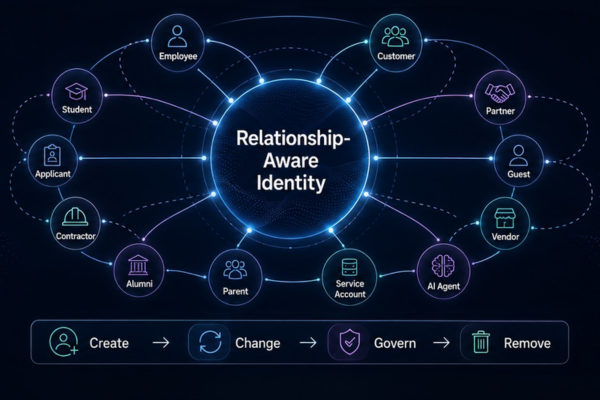
Every organization has many types of digital identities. These may include:
- Employees
- Contractors
- Students
- Faculty
- Vendors
- Partners
- Guests
- Alumni
- Service accounts
- External users
Each identity may include important information such as:
- Name
- Role
- Department
- Manager
- Affiliation
- Employment status
- Student status
- Location
- Start date
- End date
- Relationship to the organization
This identity data becomes the foundation for every access decision that follows.
If the identity record is wrong, the access decisions built on top of it may also be wrong.
For example:
- If an employee changes departments but their identity data is not updated, they may keep access from their old role while failing to receive access required for their new one.
- If a contractor leaves but their account remains active, the organization may carry unnecessary security risk without realizing it.
- If a student becomes an employee, their access may need to change based on their new relationship with the institution.
- If a vendor requires temporary access, that access should have clear limits and a defined end date.
Identity Management is not just about creating accounts.
It is about maintaining an accurate, trusted picture of every digital identity across the organization.
Access Management: Controlling What Someone Can Use
Access Management answers the next question:
What should this person be allowed to access?
This includes access to:
- Applications
- Systems
- Data
- Email groups
- File shares
- Administrative tools
- Cloud services
- Databases
- Business platforms
A simple analogy is a building badge.
Identity Management confirms who the person is.
Access Management determines which doors the badge can open.
Single Sign-On and Multi-Factor Authentication are important parts of this experience.
SSO makes access easier by allowing users to sign in once and reach multiple systems. MFA strengthens the login process by requiring another form of verification.
But SSO and MFA are not the full identity strategy.
They help answer:
Is this person able to log in securely?
They do not fully answer:
- Should this person still have this access?
- Who approved it?
- Is it appropriate for their current role?
- Has it been reviewed?
- Should it be removed automatically?
- Does this access create risk?
- Does this access violate policy?
That distinction matters.
A user can successfully pass MFA and still have access they should no longer have. A clean login experience does not automatically mean the organization has clean identity control.
Identity Governance: Proving Access Is Appropriate
Identity Governance answers one of the most important questions in modern security:
Can we prove that access is appropriate?
This is where organizations manage and validate the decisions behind access.
Identity Governance includes:
- Access requests
- Manager approvals
- Application owner approvals
- Role-based policies
- Attribute-based policies
- Access reviews
- Certifications
- Separation of duties controls
- Risk checks
- Audit trails
- Compliance reporting
Identity Governance helps organizations understand and demonstrate:
- Who has access
- Why they have it
- Who approved it
- When it was granted
- Whether it is still needed
- Whether it violates policy
- When it should be changed
- When it should be removed
This is especially important in complex organizations where users often have multiple roles, multiple affiliations, and access across many different systems.
Without governance, access can quietly accumulate over time.
Common examples include:
- Employees changing jobs but keeping old access
- Contractors moving between projects without access cleanup
- Students becoming staff members without a complete access review
- Temporary access becoming permanent
- Old accounts remaining active
- Managers approving access without understanding the risk
- Privileged access remaining in place longer than needed
Over time, these issues create hidden exposure.
Identity Governance brings structure, accountability, and evidence to the access decision process.
IAM: The Control System for Digital Trust
Identity and Access Management brings these pieces together.
IAM connects people, systems, roles, policies, risk, and business processes into one coordinated identity framework.
A mature IAM program helps answer:
- Who is this person?
- What is their relationship to the organization?
- What access should they receive?
- How should that access be approved?
- How should they authenticate?
- How should access change when their role changes?
- How should access be reviewed?
- When should access be removed?
- How can the organization prove control?
This is why IAM is much more than a login service.
IAM is the control system for digital trust.
It allows an organization to move from manual, inconsistent, ticket-driven access management to automated, policy-based identity operations.
The Identity Lifecycle: Join, Move, Review, Leave
Every identity has a lifecycle.
A person joins the organization.
They receive access.
Their role changes.
Their access changes.
They may receive temporary or privileged access.
Their access is reviewed.
Eventually, they leave.
Their access must be removed.
In many organizations, this lifecycle is still managed through a mix of:
- Tickets
- Spreadsheets
- Emails
- Manual updates
- Disconnected systems
- Informal approvals
- One-off exceptions
That model does not scale.
It creates:
- Delayed onboarding
- Inconsistent access
- Manual errors
- Audit findings
- Help desk volume
- Stale accounts
- Excessive permissions
- Unnecessary risk
Modern IAM automates the identity lifecycle using trusted source data, business rules, approval workflows, and system integrations.
For example:
- When someone is hired, access can be created based on role and policy.
- When someone transfers, access can be adjusted automatically.
- When someone needs special access, approvals can be routed to the right business owner.
- When someone leaves, access can be removed quickly and consistently.
- When access needs review, managers and data owners can certify it with clear business context.
This is where identity becomes operationally powerful.
It is not just a security control. It becomes a business enabler.
Why SSO and MFA Are Not Enough
SSO and MFA are important. Organizations should use them.
But they are not enough by themselves.
The difference is straightforward:
- SSO simplifies login.
- MFA strengthens authentication.
- IAM governs the full identity relationship.
SSO and MFA help secure the front door.
IAM determines whether the person should have a key in the first place.
Organizations that stop at SSO and MFA often still struggle with:
- Stale accounts
- Excessive access
- Slow onboarding
- Incomplete offboarding
- Manual access requests
- Rubber-stamped access reviews
- Poor audit evidence
- Fragmented identity data
- Privileged access risk
- Lack of visibility across systems
A strong authentication experience is valuable, but it does not replace identity governance, lifecycle automation, or access accountability.
Identity and Zero Trust
Zero Trust is often summarized as “never trust, always verify.”
But that verification depends on identity.
To make Zero Trust real, organizations need to understand:
- Who the user is
- What role they have
- What access they should receive
- What risk is present
- Whether the request aligns with policy
- Whether access should continue, change, or end
That requires more than a login prompt.
It requires a strong identity foundation.
Fischer Identity recognized this long before Zero Trust became a common industry message. Our approach has always centered on the idea that access should be based on verified identity, governed policy, business context, and continuous control.
That is the practical foundation of Zero Trust.
Not slogans.
Not checklists.
Not isolated tools.
Real Zero Trust depends on identity done correctly.
Why Experience Matters
Identity gets complicated quickly.
The more complex the organization, the more important the identity foundation becomes.
Higher education, healthcare, government, financial services, and large enterprises often have users who do not fit neatly into one category.
For example:
- A person may be both a student and an employee.
- A physician may also teach.
- A contractor may need temporary privileged access.
- A former employee may return as a vendor.
- External users may need controlled access to internal services.
- A researcher may need access across multiple systems, departments, or institutions.
- A service account may require governance even though it is not tied to a traditional human user.
These environments require more than basic account provisioning.
They require:
- Deep identity experience
- Flexible governance
- Strong integration
- Lifecycle automation
- Policy-based access control
- Reliable audit evidence
- A platform that can adapt to real-world complexity
That is where Fischer Identity stands apart.
For more than two decades, Fischer Identity has worked with organizations where identity is not simple, static, or one-dimensional. We have built our platform and our expertise around the realities of complex identity environments.
Identity Is Business Infrastructure
IAM should not be viewed as just another security tool.
It is business infrastructure.
Identity affects:
- How quickly people can start work
- How safely access is granted
- How reliably access is removed
- How well audits are supported
- How confidently cloud and SaaS platforms are adopted
- How effectively Zero Trust strategies are implemented
- How much risk the organization carries
When identity is weak, the organization feels it everywhere.
Users wait for access.
Help desks absorb avoidable tickets.
Managers approve access they do not fully understand.
Auditors ask questions that are hard to answer.
Security teams chase stale accounts and excessive permissions.
Leadership lacks visibility into access risk.
When identity is strong, the organization operates with more confidence.
Access becomes faster, cleaner, more consistent, and more accountable.
The Fischer Identity Perspective
At Fischer Identity, we believe identity should be clear, governed, automated, and aligned with the way organizations actually operate.
That means going beyond the login screen.
It means connecting:
- Identity data
- Access policy
- Lifecycle automation
- Governance
- Authentication
- Audit evidence
into one complete identity strategy.
SSO and MFA matter. But they are only part of the picture.
The real goal is broader:
- The right people
- The right access
- The right reasons
- The right controls
- At the right time
- With proof
That is modern IAM.
That is Identity as a Service®.
And that is where Fischer Identity continues to lead.