
Healthcare identity has reached an inflection point. For years, identity and access management was often viewed as a necessary IT control: important, operationally useful, but still largely behind the scenes. That view no longer reflects the reality healthcare organizations face today. Identity decisions now influence patient safety, clinician productivity, privacy, regulatory exposure, cyber resilience, and the ability of care teams to operate without disruption.
That is why a recent statement from our partner 1Kosmos caught my attention: “Bad actors aren’t hacking into healthcare systems. They’re logging in.” It is a direct and uncomfortable observation, but it captures the current threat landscape well. Healthcare organizations have invested heavily in securing systems, networks, and applications, but the front door is still identity. If a bad actor can acquire, misuse, or socially engineer valid credentials, they may not need to break into the environment in the traditional sense. They can simply appear to be someone the system already trusts.
That reality changes the identity conversation. Healthcare cannot rely on authentication alone, and it certainly cannot rely on passwords as a meaningful control. Even Multi-Factor Authentication (MFA), while essential, is not the entire answer if the organization cannot confidently verify the person, understand the relationship, govern the access, and respond when that relationship changes. Healthcare does not just need stronger login controls. Healthcare needs relationship-aware identity.
Healthcare Has One of the Most Complex Identity Models in Any Industry
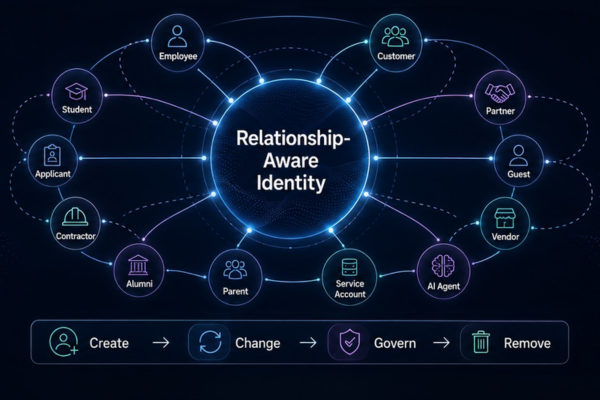
Healthcare organizations are not managing a simple workforce population. They are managing physicians, nurses, clinicians, residents, fellows, administrative staff, revenue cycle teams, traveling nurses, affiliated providers, community physicians, students, researchers, volunteers, contractors, vendors, business associates, patients, family delegates, service accounts, medical devices, application integrations, automation accounts, and emerging AI agents.
That is not one identity problem. It is an ecosystem of identity relationships. Some of these identities are employees, but many are not. Some are credentialed providers but not traditional employees. Some work across multiple hospitals, clinics, and care settings. Some need temporary access for a rotation, contract, project, or affiliation. Some represent systems, integrations, workloads, devices, or automation rather than people.
This is where traditional identity categories begin to fail. Workforce IAM alone does not capture the full healthcare identity model. Customer Identity and Access Management (CIAM) alone does not capture it either. Access Management alone is not enough. Identity Governance and Administration (IGA) alone is not enough. Healthcare needs these capabilities to work together through a governed lifecycle model that understands the relationship behind the identity.
The Real Question Is Not Whether Someone Can Log In
Too much of the identity conversation has historically centered on whether a user can authenticate. Can they log in? Did they use the right credential? Did they complete MFA? Are they in the right group? Those questions are necessary, but for healthcare they are not sufficient.
The better question is broader: who is this person or entity, what relationship do they have with the health system, what access should that relationship allow, who owns or sponsors that relationship, and what should happen when that relationship changes? A physician, a resident, a traveling nurse, a billing specialist, a vendor, a patient delegate, a service account, and an AI agent may all need access, but each represents a very different relationship with different levels of assurance, risk, ownership, and governance.
Authentication verifies access at the front door. Identity governance determines whether that access is justified. Relationship-aware identity determines whether that access still matches the person’s or entity’s current relationship with the organization. Healthcare needs all three working together, especially as the attack surface expands and clinical operations become more digitally dependent.
Why Relationship-Aware Identity Matters in Healthcare
Every identity represents a relationship. In healthcare, that relationship may be clinical, operational, administrative, academic, contractual, patient-facing, technical, or non-human. A clinician relationship may justify access to clinical applications. A revenue cycle relationship may justify access to billing and claims systems. A contractor relationship may justify temporary access to a project environment. A vendor relationship may justify limited support access. A patient relationship may justify portal access. A family delegate relationship may justify carefully scoped access to another person’s information. A service account may justify system-to-system access, while an AI agent may justify access to specific data, tools, or workflows within approved boundaries.
The access should match the relationship. When the relationship changes, access should change. When the relationship ends, access should be removed. When the relationship becomes higher risk, governance should respond. That sounds straightforward, but it is difficult to execute if identity logic is scattered across directories, scripts, spreadsheets, custom workflows, application-specific controls, and manual processes.
Healthcare organizations need a platform model that can understand these relationships, apply policy, manage lifecycle, and govern access without forcing every population into a narrow identity category. This is where Fischer Identity’s relationship-aware approach becomes especially relevant.
Credential Theft Requires a Stronger Identity Strategy
Credential theft, phishing, account takeover, social engineering, and misuse of legitimate access continue to challenge healthcare because healthcare environments are high-pressure, highly distributed, and operationally complex. Clinicians and frontline workers need fast access. Administrators need access across operational systems. Vendors and affiliated providers often need access without fitting cleanly into traditional employee models. Patients and delegates need access to digital services. Service accounts and integrations run quietly behind the scenes.
This creates a large and complicated identity attack surface. Traditional authentication may validate possession of a credential, but healthcare increasingly needs stronger assurance that the person using the credential is the legitimate person. Biometric identity verification, identity proofing, and phishing-resistant authentication can improve that assurance. That is where partner capabilities such as 1Kosmos are important, because they help organizations strengthen the connection between the credential and the real person using it.
But assurance must be paired with governance. A strongly verified user with excessive access is still a risk. A legitimate clinician with stale access from a previous role is still a risk. A vendor account with no current sponsor is still a risk. A service account with no owner is still a risk. An AI agent with expanding permissions and weak oversight is still a risk.
The strongest healthcare identity strategy connects verification, authentication, lifecycle management, access governance, signals, and continuous identity state. In plain terms, healthcare organizations need to verify the person, understand the relationship, grant the right access, govern that access, respond to signals, and change or remove access when the relationship changes.
Healthcare Needs Continuous Identity State
Healthcare identity cannot depend only on periodic access reviews or one-time onboarding events because the environment changes too quickly. People change departments. Providers change credentialing status. Residents rotate. Traveling nurses complete assignments. Vendors come and go. Contracts expire. Patients update delegate access. Systems are replaced. Service account ownership changes. AI-enabled workflows evolve.
This is why healthcare needs continuous identity state. Current access should remain aligned with current relationship, current role, current ownership, current policy, current signals, and current risk. Signals should not simply be collected; they should drive governed action. Employment status, credentialing status, department or facility changes, contract end dates, rotation end dates, sponsorship changes, patient relationship changes, vendor status, account inactivity, access review outcomes, authentication signals, risk events, service account ownership changes, and AI agent scope changes all matter because they can indicate that identity state and access state are drifting apart.
A signal that a contractor engagement has ended should trigger access review or removal. A signal that a provider is no longer credentialed should affect access. A signal that a vendor account has no sponsor should trigger governance. A signal that a service account has lost its owner should trigger review. A signal that an AI agent’s scope has expanded should trigger policy evaluation. This is how healthcare moves from static access administration to continuous identity control.
Code-Free Configuration Is Critical for Healthcare
Healthcare does not stand still. Health systems merge. Clinics are acquired. Provider groups affiliate. Departments reorganize. New applications are introduced. Regulations shift. Contracts change. AI and automation create new identity scenarios. If every identity change requires custom code, scripts, professional services, or brittle one-off workflows, the identity program cannot keep pace.
That is one of the reasons Fischer Identity is such a strong fit for healthcare. We believe complex identity should be modeled, not hard-coded. Healthcare organizations need lifecycle rules, access policies, approval paths, ownership models, delegated access, reviews, expiration logic, exception handling, and governance workflows that can be configured inside the platform rather than buried in custom code.
This matters because healthcare identity complexity is not a temporary condition. It is the operating reality. A platform that requires a development project every time the business changes will eventually become part of the problem. A platform that allows the organization to configure, govern, and adapt identity processes becomes part of the solution.
Why Fischer Identity Is the Right Choice for Healthcare
Fischer Identity brings a relationship-aware identity model to healthcare. Our platform helps organizations manage identity across complex populations through one configurable, code-free lifecycle and governance platform. That includes workforce users, affiliated providers, contractors, vendors, patients, delegates, students, researchers, service accounts, non-human identities, and emerging AI agents.
For healthcare organizations, this means Fischer Identity can support joiner, mover, leaver lifecycle automation; affiliated and non-employee identity management; contractor and vendor access governance; sponsored and temporary access; patient and customer-like identity scenarios; delegated access models; access governance and review processes; password and self-service processes; Single Sign-On (SSO) and MFA integration; service account ownership and lifecycle governance; non-human identity governance patterns; signal-driven identity action; continuous identity state; and code-free configuration for complex business rules.
That breadth matters because healthcare identity cannot be solved by a single narrow control. It requires a coordinated model that connects identity assurance, lifecycle automation, access governance, and continuous state. Through partner capabilities such as 1Kosmos, healthcare organizations can strengthen identity verification, biometric authentication, and higher-assurance identity experiences where needed. Fischer Identity then helps ensure that the person, system, service account, or AI agent has the right access based on the right relationship, lifecycle state, policy, and governance model.
That combination points toward a stronger future for healthcare identity: one where the organization can trust the person at the keyboard, understand the relationship behind the access, and continuously govern whether that access remains appropriate.
A Forward-Looking Healthcare Identity Model
Healthcare organizations need to move beyond the idea that identity is simply an IT control. Identity is now part of cyber resilience, patient trust, operational continuity, clinical productivity, regulatory readiness, and the safe adoption of automation and AI.
The organizations that lead in healthcare identity will be the ones that can answer the hard questions with confidence. Do we know who is accessing our systems? Do we know whether they are truly the person they claim to be? Do we know what relationship justifies their access? Do we know who owns or sponsors that relationship? Do we know when that relationship changes? Do we know whether access still matches current policy and risk? Do we know how to govern both human and non-human identities? Do we know how to adapt without rewriting the identity program every time healthcare changes?
That is the standard healthcare should demand, and it is the standard Fischer Identity is built to support.
Healthcare identity is not just access. It is assurance, lifecycle, governance, risk control, operational discipline, and trust. The healthcare organizations that get this right will not treat workforce identity, customer identity, provider identity, vendor identity, patient identity, service account governance, and AI identity as disconnected problems. They will manage them as identity relationships.
Every identity is a relationship. Every relationship has a lifecycle. Every lifecycle needs governance.
Fischer Identity is ready to help healthcare organizations make that shift.
One platform. Every relationship. Continuous identity control.