Healthcare identity is not a simple login problem. It is a patient safety, privacy, compliance, and operational readiness problem. Every access decision has a downstream effect: a clinician must have the right EHR access before a shift begins, a traveling nurse needs temporary access that expires cleanly, a resident rotates between departments, a vendor needs tightly scoped access, and a terminated worker must lose access before risk lingers in clinical systems.
That is why healthcare organizations need more than SSO, MFA, or a disconnected access review tool. They need a true Identity Governance and Administration platform that can manage the full identity lifecycle across employees, clinicians, contractors, non-employed providers, students, residents, affiliates, service accounts, cloud systems, legacy directories, and electronic health record environments. Fischer Identity is built for that level of complexity.
The HIPAA Security Rule requires covered entities and business associates to control access to electronic protected health information, including unique user identification and emergency access procedures. HHS also emphasizes that access must remain appropriate as workforce roles change. In practical terms, that is exactly where IAM and IGA must perform: establishing, modifying, reviewing, proving, and removing access with confidence. HHS HIPAA Security Rule reference
Healthcare IAM Starts with the Lifecycle
A healthcare identity program succeeds or fails on lifecycle management. The hard part is not creating one account. The hard part is knowing who the person is, why they need access, what source system owns the decision, which role or privilege applies, when access should start, when it should change, and when it must end.
Fischer Identity addresses this with automated joiner, mover, leaver processing; strong identity matching; policy-based access decisions; access certifications; and real-time provisioning and deprovisioning. Instead of depending on manual tickets, spreadsheets, or fragile scripts, Fischer Identity allows healthcare organizations to define the business rules that govern identity and then execute those rules consistently across connected systems.
For hospitals, academic medical centers, and healthcare consortiums, that matters in everyday situations:
- A new nurse completes HR onboarding and needs access to directory services, email, timekeeping, clinical applications, and the EHR before the first shift.
- A physician changes departments and requires a different clinical access profile without carrying forward unnecessary legacy access.
- A resident or fellow rotates through multiple services and needs time-bound access based on rotation dates.
- A non-employed provider needs governed access without being forced into an employee-only identity model.
- A vendor or contractor needs temporary access that is sponsored, approved, reviewed, and automatically removed.
- A terminated employee, expired contractor, or inactive account must be deprovisioned quickly to reduce orphaned account risk.
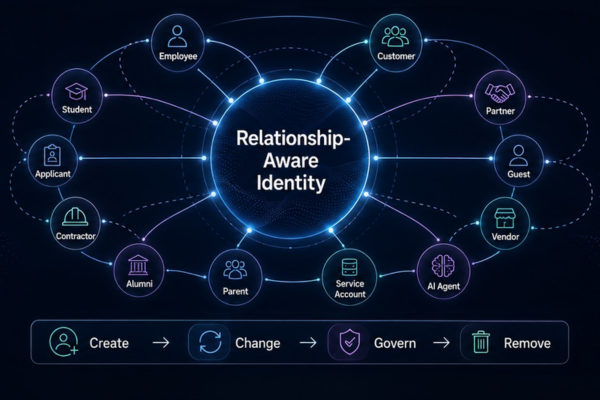
This is where Fischer Identity separates itself. It does not treat healthcare users as one generic workforce population. It supports the real-world identity states healthcare organizations live with every day: clinician, employee, provider, student, resident, affiliate, contractor, volunteer, vendor, partner, retiree, and more.
Native Oracle Health / Cerner Identity Integration
Healthcare organizations using Oracle Health, formerly Cerner, need identity governance that connects into the clinical ecosystem, not around it. Fischer Identity has a native Oracle Health connector designed for Oracle Health Millennium environments. The connector provides identity and provisioning integration through SPML-based APIs and is designed to manage Oracle Health Personnel entities and related account functionality for clinical and administrative users. Fischer Identity Oracle Health integration
That is a significant differentiator. EHR access is one of the most sensitive and operationally critical areas in healthcare. If EHR provisioning is manual, delayed, disconnected from HR or credentialing events, or cleaned up only during periodic audits, risk accumulates fast. Fischer Identity helps healthcare organizations automate Oracle Health user lifecycle processes while keeping access tied to identity attributes, policies, approvals, and governance controls.
This is the difference between simply authenticating a user and actually governing the identity. Authentication asks, “Can this person sign in?” Identity governance asks, “Should this person have this access, in this system, for this reason, at this time, and can we prove it?”
Proven in Complex Institutions with Healthcare-Scale Identity Problems
Fischer Identity has more than 20 years of experience solving complex IAM and IGA problems. It may not be the loudest vendor in the market, and it does not spend its energy trying to out-market every larger competitor. Fischer invests in the product, the customer experience, and the hard identity problems most organizations cannot solve with out-of-the-box access tools alone.
That experience matters for healthcare. Many of the hardest healthcare identity problems look very similar to the identity problems found in large research universities with academic medical centers: multiple authoritative systems, complex affiliation models, strict compliance needs, clinical and research populations, non-employee users, legacy applications, cloud services, and a constant flow of onboarding, role changes, and offboarding events.
A clear example is the University of Virginia. UVA is an R1 academic institution with a major academic medical center, regional trauma center, and regional medical clinics across the state. Fischer Identity replaced a legacy home-grown IAM environment that struggled with real-time processing, cloud readiness, delayed provisioning, inconsistent deprovisioning, unclear source-of-authority logic, in-person credentialing, duplicate identities, and fragmented user experiences. After implementation, UVA achieved automated provisioning and deprovisioning, streamlined account claim, centralized password and recovery services, external account reconciliation, and stronger identity matching.
The scale is important: Fischer Identity now manages 120,000+ active users and almost 2 million identity accounts for UVA. These outcomes were achieved within one year of signing the implementation contract. Six months after go-live, UVA consolidated three HR systems into Workday HCM, and Fischer Identity handled that source-system transition through configuration changes and coordinated testing rather than a major reimplementation.
That is not a small proof point. If a platform can support a large university ecosystem with a major healthcare component, multiple populations, clinical operations, research needs, contractors, students, faculty, staff, external identities, and a major HCM transition, then it is well positioned for freestanding hospitals, regional health systems, integrated delivery networks, and healthcare consortiums facing the same identity complexity.
Healthcare Use Cases Fischer Identity Is Built to Solve
| Healthcare use case |
How Fischer Identity helps |
| Clinician onboarding and first-day access |
Automates access from HR, credentialing, directory, and clinical application data so authorized users are ready on time. |
| Oracle Health / Cerner provisioning |
Native connector supports identity and provisioning use cases for Oracle Health Personnel records. |
| Non-employed provider governance |
Manages physicians, specialists, researchers, and affiliates with sponsorship, expiration, policy controls, and reviews. |
| Resident, fellow, and student rotations |
Time-bound access follows rotation dates, department placement, and affiliation status without duplicate identities. |
| Contract, agency, and vendor access |
Temporary workers can be governed with owners, expiration dates, renewal workflows, MFA, and automated removal. |
| Access reviews and audit readiness |
Certifications help prove who has access, why, who approved it, and when it changed. |
| Offboarding and orphan account remediation |
Policy-driven deprovisioning reduces persistent access after workers, contractors, or affiliates leave. |
| Hybrid healthcare environments |
Fischer Identity supports cloud, on-prem, AD, LDAP, ERP/HCM, ITSM, and clinical application environments. |
Why No-Code Configuration Matters in Healthcare
Healthcare changes constantly. Hospitals acquire clinics. Providers rotate. Credentialing rules change. EHR access profiles evolve. Departments reorganize. Regulatory expectations shift. A custom-coded IAM platform turns every change into a mini-development project, and every upgrade into a risk event.
Fischer Identity takes a configuration-first approach. Healthcare organizations can define policies, workflows, access rules, role logic, identity matching behavior, provisioning rules, and deprovisioning actions without building a fragile layer of customer-owned custom code. That matters because healthcare IAM must be sustainable. The platform cannot depend on a handful of developers or undocumented scripts to keep access moving.
Fischer Identity supports RBAC, ABAC, and PBAC patterns, allowing healthcare organizations to avoid role bloat while still enforcing precise access. For example, a nurse’s access can be shaped by employment status, department, facility, job code, location, credentialing status, employment type, contract dates, and application-specific requirements. That is more realistic than trying to force every healthcare access decision into a static role model.
Security, Compliance, and Operational Confidence
Healthcare leaders need confidence that access controls are not just written in policy documents but actually enforced across systems. Fischer Identity helps organizations operationalize least privilege, reduce orphaned accounts, centralize external identity governance, automate access reviews with continuous compliance, and strengthen audit evidence. The platform can help answer the questions auditors, CISOs, compliance teams, and clinical leaders care about: Who has access? Why do they have it? Who approved it? When was it last reviewed? When should it be removed?
That visibility is especially important for healthcare consortiums and multi-entity health systems. These organizations often include hospitals, outpatient clinics, physician groups, research operations, vendors, contracted workers, and shared services. Without a strong identity governance platform, access decisions become fragmented across local teams, ticket queues, EHR administrators, spreadsheets, and legacy systems. Fischer Identity brings that complexity under one governed identity model.
The Bottom Line
Fischer Identity is the best IAM and IGA choice for healthcare organizations that need more than authentication. It is built for identity lifecycle management, healthcare identity governance, Oracle Health/Cerner provisioning, clinician onboarding, non-employed provider access, external identity management, hybrid integration, access reviews, audit readiness, and automated deprovisioning.
Healthcare organizations do not need a product that only works well in a clean, cloud-only environment. They need a platform that understands messy identity reality and can still deliver speed, governance, and control. Fischer Identity has already proven that capability in large, complex environments with major healthcare components. For hospitals, academic medical centers, integrated delivery networks, and healthcare consortiums, that experience matters.
The future of healthcare depends on fast, safe, and governed access. Fischer Identity gives healthcare organizations the identity foundation to support clinicians, protect patients, reduce operational drag, and prove compliance without burying the organization in custom code or manual workarounds.