There is a familiar story across many colleges, universities, healthcare systems, and large enterprises. Twenty or more years ago, the organization needed a way to manage identities, accounts, passwords, access, and onboarding. At the time, the market may not have offered a product that understood the organization’s complexity, especially if that organization had students, employees, faculty, contractors, alumni, retirees, researchers, vendors, affiliates, guests, and other populations moving through different lifecycle states.
So, the institution did what capable technical teams often do. It built something.
For years, that homegrown system worked well enough. It created accounts. It moved data between systems. It supported password resets. It handled enough provisioning to keep the institution moving. It became part of the operational foundation, supported by scripts, scheduled jobs, internal knowledge, manual workarounds, and a small number of people who understood how all the pieces fit together.
But time has a way of exposing the limits of systems that were built for a different era.
What once felt practical can slowly become fragile. What once felt flexible can become difficult to maintain. What once felt cost-effective can become expensive in hidden ways. The system still runs, but every year it struggles more. Every modernization project adds pressure. Every new cloud platform introduces another integration challenge. Every audit raises more questions. Every departure of a key technical employee creates more concern. Every manual process becomes another opportunity for delay, error, or risk.
The issue is not that the homegrown system failed. In many cases, it did exactly what it was designed to do. The issue is that the institution changed, the threat landscape changed, and the expectations placed on identity changed.
At some point, the question is no longer whether the homegrown system has served the organization well. The question becomes whether it can continue to protect and enable the organization in the world we live in now.
The Signs Are Usually Clear
Most institutions know when their legacy IAM environment is beginning to hold them back. They may not always describe it that way, but the signs are usually there.
New employees cannot claim their accounts until the first day of employment. Students cannot gain access until move-in or until a manual process is completed. Remote workers, adjunct faculty, researchers, and affiliates experience delays before they can begin their work. The service desk becomes the safety net for processes that should have been automated years ago.
Password management is often scattered across multiple websites, each with different rules, different user experiences, and different levels of reliability. One tool resets one password. Another tool handles another system. Some populations are supported well, while others require help desk intervention. Users become frustrated, and IT absorbs the cost.
Provisioning and deprovisioning are often driven by scheduled batch jobs that run overnight, weekly, or according to fragile timing dependencies. When they work, everyone moves on. When they fail, access is delayed, removed incorrectly, or left active longer than it should be. In a modern threat environment, those timing gaps matter.
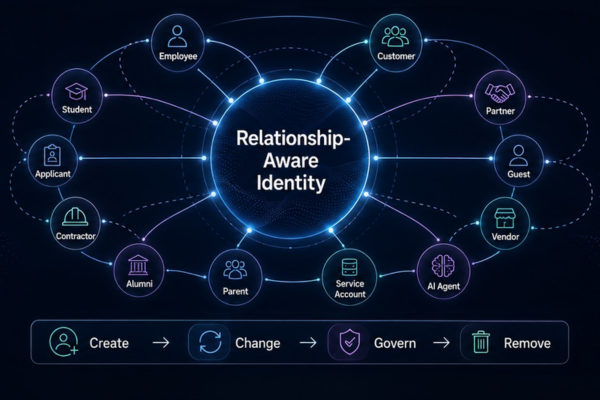
The institution may also struggle to manage the real complexity of its own identity lifecycle. Higher education is a perfect example. A person may be a student today, an employee tomorrow, an alumnus later, and a contractor or faculty member years after that. Some people hold multiple roles at the same time. Some roles need early access. Some need grace periods. Some require immediate deprovisioning. Some access must continue after a relationship changes, while other access must stop immediately.
A basic account creation system cannot solve that problem. A collection of scripts cannot sustainably govern that problem. A homegrown platform built 20 years ago was probably never designed for the complexity institutions face today.
The “We Are Too Complex” Argument
One of the most common reasons organizations stay with a homegrown IAM system is the belief that no commercial product can match their complexity. That belief is understandable, especially for institutions that have been burned by vendors, consultants, expensive implementation projects, or products that looked polished in a demo but failed when exposed to real operational complexity.
The concern is fair. Many IAM products were not built for higher education complexity. Many were designed around cleaner corporate workforce models where a person is hired, receives access, changes jobs occasionally, and eventually leaves. That model does not reflect the reality of universities, academic medical centers, research institutions, or large organizations with complex internal and external populations.
However, “we are too complex” can become a trap. It can keep an organization tied to an aging system long after the risk outweighs the comfort. It can prevent leaders from evaluating modern platforms that were intentionally built to handle complexity without forcing the organization into endless custom code.
The real question is not whether the institution is complex. It is.
The better question is whether the current system is still the best way to manage that complexity.
Fischer Identity was purpose built for organizations that have complex identity lifecycles, multiple sources of authority, overlapping roles, external identities, hybrid technology environments, and business processes that cannot be reduced to a simple workforce identity model. Our platform is designed to support the way complex institutions actually operate, not the way a generic product assumes they should operate.
Manual Onboarding Is Now a Business Risk
Manual onboarding may have been acceptable when most people arrived physically on campus or at an office before they needed access. That is no longer how modern organizations work.
Today, students expect access before they arrive. Employees need access before their first day. Faculty may need access before relocating. Researchers may need access to collaboration environments quickly. Contractors and vendors often need temporary access with defined start and end dates. A delayed account is not just an inconvenience. It can delay productivity, increase support costs, frustrate users, and create pressure for risky exceptions.
The account claim process is now a critical part of the identity lifecycle. It should be secure, flexible, and intuitive. It should validate that the person claiming the account is the right person. It should support different onboarding paths for students, employees, faculty, guests, contractors, and other populations. It should allow the institution to align account creation with HR, SIS, admissions, background checks, sponsorship, identity proofing, and institutional policy.
If the first step in the digital relationship is manual, inconsistent, or dependent on help desk intervention, the institution is already operating from behind.
Fischer Identity provides a mature identity claim process that can support secure remote onboarding, user validation, account setup, password creation, MFA enrollment, recovery information, and role-specific onboarding experiences. This is not simply a convenience feature. It is a security control, an operational improvement, and a better user experience.
Password Reset Should Not Be a Scavenger Hunt
Password reset is often where users feel the pain of a fragmented IAM environment most directly. When an institution has multiple password reset websites, inconsistent rules, and unreliable synchronization, users lose confidence. The service desk becomes overwhelmed with avoidable calls. IT staff spend time helping people recover access instead of improving the environment.
A modern IAM program should give users a clear, centralized place to manage their identity. They should be able to reset passwords, manage MFA devices, update recovery information, and complete approved self-service actions without needing to understand the complexity behind the scenes.
Fischer Identity supports a unified identity experience that can simplify password management across complex environments. This is especially important for institutions that still operate a mix of cloud systems, on-premise systems, directories, ERP platforms, learning systems, research systems, and legacy applications. The user should not have to understand the architecture in order to regain access. The platform should handle that complexity.
Batch Processing Creates Security Gaps
Scheduled batch processing was once the standard approach for moving identity data between systems. In many homegrown environments, it still is. The problem is that modern security does not move on a batch schedule.
When a person is terminated, changes roles, loses eligibility, becomes inactive, or no longer requires access, the institution needs timely enforcement. A failed batch job or delayed feed can leave access active longer than intended. That may not seem significant until the wrong account is used to access payroll, financial aid, research data, student records, health information, or administrative systems.
The same issue applies to provisioning. If access is delayed because a batch process did not run properly, the organization loses productivity and creates pressure for manual overrides.
Fischer Identity supports automated, policy-driven provisioning and deprovisioning based on identity attributes, roles, affiliations, and institutional rules. Instead of relying on fragile timing and manual intervention, organizations can move toward a more reliable identity model where access is continuously aligned with the person’s current relationship to the institution.
That is the direction modern IAM must go. Identity cannot be treated as a nightly data movement exercise. It must become an active governance function.
Identity Matching Is Where Complexity Gets Real
One of the hardest problems in identity management is knowing whether two records represent the same person. This is especially true in higher education, where people move between roles and may appear in multiple systems over time.
A student becomes a staff member. A staff member enrolls in a degree program. A contractor becomes an employee. A visiting scholar returns years later as faculty. An alumnus becomes a donor, volunteer, researcher, or board member. A person may exist in HR, the student information system, advancement, housing, research administration, medical systems, or a departmental database.
If the IAM system cannot accurately match and reconcile identities, the institution ends up with duplicate accounts, fragmented access, poor auditability, and increased security risk.
Fischer Identity is built to manage complex identity matching across multiple authoritative sources. This allows organizations to preserve a single digital identity where appropriate, understand the person’s full relationship with the institution, and apply access policies based on the complete identity context.
For engineers and architects, this matters because it creates a cleaner and more sustainable identity model. For executives, it matters because it reduces risk, improves compliance, and strengthens institutional visibility.
External Identities Cannot Be Left in Spreadsheets
Employees and students are only part of the identity picture. Many organizations also manage vendors, volunteers, contractors, visiting scholars, research collaborators, board members, sponsored guests, unpaid faculty, retirees, alumni, service providers, and other external populations.
These populations often do not live cleanly in HR or the student system. That is where homegrown processes tend to become especially risky. External identities may be tracked in spreadsheets, emails, departmental databases, or ticketing systems. Access may be granted manually. Expiration dates may be unclear. Sponsors may change roles. Renewals may not happen consistently. Deprovisioning may depend on someone remembering to submit a request.
This is not sustainable.
External identities need governance. They need ownership, sponsorship, start dates, end dates, access reviews, policy enforcement, and lifecycle automation. They should not be treated as exceptions simply because they do not fit traditional employee or student models.
Fischer Identity can help organizations manage external identities with the same discipline applied to internal populations. The platform can support sponsored accounts, approvals, expiration policies, renewals, role-based and policy-based access, password policies, and automated deprovisioning. That gives institutions a better way to manage populations that are often among the hardest to govern.
The Cost Concern Is Real, But So Is the Cost of Doing Nothing
Many organizations delay IAM modernization because they fear the cost. That concern is not imaginary. Some IAM programs become extremely expensive, especially when the selected product requires heavy customization, outside development, implementation partners, separate modules, bolt-on tools, and ongoing technical dependency.
No institution wants to spend millions of dollars purchasing a product only to discover that it still needs custom code, external processes, and expensive support to meet the organization’s real requirements.
That is why Fischer Identity’s approach matters.
Fischer Identity is a configurable, no-code IAM and IGA platform designed to handle complex requirements without forcing customers into custom development. Our goal is not to sell a product that becomes another fragile technical dependency. Our goal is to provide a sustainable identity platform that can be configured, adapted, and expanded as the organization evolves.
We also understand that institutions need predictable costs. IAM modernization should not become an open-ended financial commitment where every requirement becomes a new invoice. Fischer Identity provides a practical path for organizations that need enterprise-grade identity governance without the runaway costs often associated with large IAM implementations.
The cost of doing nothing should also be part of the conversation. Manual onboarding has a cost. Password reset calls have a cost. Failed provisioning has a cost. Inconsistent deprovisioning has a cost. Security incidents have a cost. Audit findings have a cost. Lost productivity has a cost. Retaining a fragile system because it appears cheaper can be a very expensive decision over time.
Proven Where Complexity Is Highest
Fischer Identity is trusted by some of the most complex organizations in higher education and enterprise environments. We manage identity at scale for major R1 institutions and large organizations that cannot afford fragile lifecycle management, inconsistent access controls, or identity processes that depend on custom code and tribal knowledge.
At the University of Virginia, Fischer Identity helped replace a legacy homegrown IAM environment that struggled with real-time processing, inconsistent deprovisioning, in-person credentialing, unclear source of authority issues, and operational strain during onboarding. Fischer Identity introduced streamlined identity claim, automated provisioning and deprovisioning, advanced matching, centralized self-service, unified password management, DUO device management, preferred name management, and improved visibility across the identity environment.
That transformation supported more than 180,000 active users and nearly 2 million identity accounts. It also positioned UVA to handle a major Workday HCM transition only months after go-live through configuration changes rather than custom redevelopment.
That is the difference between a product that merely creates accounts and a platform that supports institutional change.
What This Means for Technical Leaders
For engineers, IAM architects, and IT leaders, the challenge is practical. You need a platform that can integrate with existing systems, support hybrid environments, manage multiple sources of authority, handle complex lifecycle logic, reduce scripts, support account claim, automate deprovisioning, and give administrators enough control to manage change without constantly relying on custom development.
You also need a platform that can support where the institution is going, not just where it is today. ERP systems are modernizing. Cloud adoption is accelerating. AI-enabled systems are beginning to influence business processes. Data expectations are increasing. Security teams need more timely enforcement. Auditors want better visibility. Users expect easier access.
Fischer Identity gives technical teams a platform that can support that future while respecting the complexity of the current environment. It can connect to cloud systems, on-premise systems, ERP platforms, directories, service management tools, and other institutional applications. It can support identity lifecycle automation across diverse populations and provide the configuration flexibility needed to adapt as business rules change.
The goal is not to replace one complicated system with another complicated system. The goal is to reduce fragility and create a sustainable identity foundation.
What This Means for Executive Leaders
For executive leadership, IAM modernization is not just an IT project. It is a business risk, security, compliance, and operational effectiveness issue.
Identity touches almost every part of the institution. It affects how quickly employees become productive, how students access services, how researchers collaborate, how financial systems are protected, how payroll changes are secured, how access is removed, how audits are supported, and how the organization responds to threats.
When identity processes are outdated, the risk is often distributed across the organization. No single failure may appear catastrophic at first. Instead, the institution accumulates small weaknesses: delayed access, excessive permissions, orphaned accounts, duplicate identities, inconsistent password tools, manual approvals, incomplete records, and poor visibility.
Eventually, those weaknesses become material risk.
Modern IAM gives leadership a stronger foundation for institutional trust. It improves the user experience, reduces operational friction, strengthens security, supports compliance, and allows the organization to move faster without losing control.
That is the business impact.
The Wall Is Not a Strategy
Many organizations remain stuck between two uncomfortable options. They know their homegrown system is aging, but they fear that commercial IAM products will be too expensive, too rigid, or too dependent on customization. So they wait.
They keep the system running. They add another script. They create another manual process. They document another exception. They ask the same small group of people to keep carrying the institutional identity model forward.
But waiting is not neutral. Every year the institution waits, the environment becomes more complex. The systems move faster. The threats become more sophisticated. The people who understand the old system move closer to retirement or leave for other opportunities. The custom logic becomes harder to explain. The risks become harder to see.
At some point, sitting on the wall becomes the riskiest option.
Fischer Identity Was Built for This Moment
Fischer Identity is not trying to be the loudest company in the IAM market. We have built our reputation by solving hard identity problems, especially in environments where complexity is real and generic approaches fall short.
We are a quiet underdog in the industry, but that is by choice. Instead of spending millions trying to dominate the conversation, we invest in the product, the customer experience, and the long-term success of the organizations we serve.
For more than 20 years, Fischer Identity has helped institutions manage complex identity lifecycles, automate provisioning and deprovisioning, support account claim, govern external identities, integrate across hybrid environments, reduce manual work, and modernize IAM without unnecessary custom code.
We understand higher education. We understand complex enterprise identity. We understand that identity is not only about technology. It is about people, process, policy, risk, and institutional mission.
The Better Path Forward
A homegrown IAM system that has been in place for 20 years deserves respect. It likely carried the institution through years of change and solved problems that were very real at the time. But respect for the past should not prevent a better future.
Modern IAM requires more than account creation. It requires secure onboarding, account claim, identity proofing, lifecycle automation, access governance, accurate matching, password and MFA management, external identity governance, policy enforcement, hybrid integration, auditability, and the ability to adapt as the organization changes.
Fischer Identity delivers these capabilities in a purpose-built platform designed for complex institutions that cannot afford brittle identity processes or endless customization.
You do not have to accept the belief that your organization is too complex for a modern IAM platform.
You do not have to spend millions on a product only to build another layer of custom code around it.
You do not have to wait for a security incident, audit finding, failed onboarding cycle, or key employee retirement to force the conversation.
The institution has already changed.
The systems around it have changed.
The threat environment has changed.
Now identity must change with it.
Fischer Identity is ready to help organizations move from legacy complexity to modern identity governance, with a platform built for the real-world challenges institutions face every day.