Why Real-World Identity Complexity Requires a Platform Built for More Than the Demo
Identity and Access Management is one of the most important technology decisions an organization will make.
- It determines how people gain access.
- How access changes.
- How access is removed.
- How risk is reduced.
- How compliance is proven.
- And how confidently the organization can operate as roles, systems, and business needs evolve.
That is why IAM vendor selection is rarely simple. Organizations invest significant time into RFPs, demonstrations, scoring matrices, stakeholder reviews, and purchasing processes. Yet even after a formal selection process, we continue to see a familiar pattern.
- Organizations choose a vendor.
- Implementation begins.
- Real data enters the system.
- Real users appear.
- Real business rules surface.
And then the questions begin.
- Why can’t the platform handle the complexity of our multi-role users?
- Why does account claim require additional tools?
- Why are we writing custom code so early in the project for simple processes?
- Why does the policy engine work in simple scenarios but struggle with our actual processes?
- Why is deprovisioning not as precise as we expected?
- Why are we adding bolt-on systems just to make the implementation work?
At that point, the issue is no longer a purchasing decision. It is an operational realization. The organization discovers that the vendor’s story sounded complete, but the platform was not built for the full complexity of the environment.
That is the problem this article is meant to address.
Not every IAM platform is built the same. Not every platform is prepared for complex lifecycle management. Not every vendor can support real-time, policy-driven identity governance without custom code, manual workarounds, or additional systems.
Fischer Identity was built for that complexity. And we have been doing this for years.
The Gap Between What Is Sold and What Actually Works
Most IAM platforms can tell a compelling story during a sales process.
- They can show clean workflows.
- They can demonstrate basic onboarding.
- They can provision a user into a target system.
- They can show an access review.
- They can describe policy-based access.
- They can answer many RFP questions with confidence.
But the true test of an IAM platform does not happen in a controlled demo. It happens when the platform must support the organization’s real operating model. That is where complexity appears.
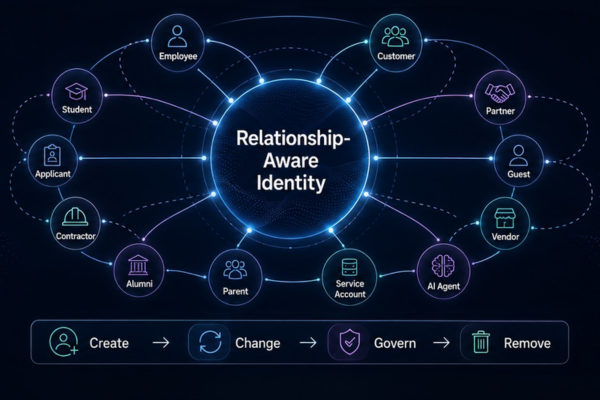
- A user may be both an employee and a student.
- A contractor may later become a full-time employee.
- A retired employee may retain limited access.
- A visiting researcher may need temporary access tied to a sponsor.
- A vendor may need access for a fixed period.
- A board member may require access but may not exist in HR.
- An alumnus may return as faculty.
- An employee may hold multiple appointments.
- A person may exist in several source systems with inconsistent data.
These are not rare exceptions. For many organizations, especially in higher education, healthcare, research, government, and large enterprises, these are normal identity conditions.
The problem is that many IAM platforms are designed around simplified assumptions:
- One person has one role
- One system is the source of truth
- Access changes happen at predictable times
- Lifecycle events are clean and linear
- Role structures remain manageable
- Deprovisioning is straightforward
- Account claim is a basic onboarding step
That may work in a simple environment. It does not work in a complex one. When a platform is not designed for real-world identity complexity, the organization is forced to adjust its processes to fit the tool. That is backwards. IAM should support the business. The business should not have to shrink itself to fit the IAM product.
Complexity Is Not the Edge Case
A common mistake in IAM planning is treating complexity as an exception. It is not. Complexity is the standard.
Every mature organization has overlapping populations, inconsistent data sources, special access conditions, on premise legacy systems, cloud platforms, manual processes, compliance obligations, and users who do not fit neatly into one category.
The real question is whether the IAM platform can manage that complexity cleanly.
- Can it maintain one identity for a person across multiple roles?
- Can it evaluate access continuously as attributes change?
- Can it provision and deprovision based on policy, not manual intervention?
- Can it support different onboarding paths for different populations?
- Can it manage external identities with clear ownership and expiration?
- Can it prevent role bloat instead of contributing to it?
- Can it do all of this without custom code?
This is where Fischer Identity stands apart.
Fischer Identity was built to manage highly complex identity lifecycles across diverse populations, systems, and policies. Our platform supports the reality that identity is not static. It changes constantly as people move through an organization, take on new roles, leave old roles, return, affiliate, contract, retire, or interact with the organization in different ways.
Many vendors struggle when identity gets complicated. Fischer Identity expects it.
Lifecycle Management Means More Than Provisioning
One of the most overused phrases in IAM is “lifecycle management.” Many vendors use it to describe basic provisioning. That is not enough. True lifecycle management means managing the full identity journey from initial creation through every role change, access change, status change, and eventual deprovisioning event.
It includes:
- Identity creation
- Identity matching
- Account claim
- Role assignment
- Access provisioning
- Attribute changes
- Role transitions
- Grace periods
- Access expiration
- Deprovisioning
- Rehire or return scenarios
- External identity renewal
- Auditability and reporting
A platform that only creates accounts is not delivering full lifecycle management. A platform that cannot handle multi-role users is not delivering full lifecycle management. A platform that requires custom scripts for complex transitions is not delivering full lifecycle management. A platform that cannot reliably remove access when it is no longer justified is not delivering full lifecycle management.
Fischer Identity delivers lifecycle management as a core platform capability. Our product supports complex identity states, multiple sources of authority, dynamic role transitions, and policy-driven access decisions within a unified system. This allows organizations to automate identity processes without relying on fragile custom code or manual exceptions. That matters because lifecycle failures are not minor inconveniences. They create real risk.
- Delayed access affects productivity.
- Duplicate accounts create confusion and exposure.
- Over-provisioning increases security risk.
- Poor deprovisioning leaves accounts active after they should be removed.
- Manual workarounds increase operational cost.
- Inconsistent enforcement weakens compliance.
The cost of weak lifecycle management grows over time. That is why organizations should evaluate IAM platforms based not on what they can demonstrate in a simple workflow, but on what they can sustain in real operational conditions.
Account Claim Cannot Be an Afterthought
Account claim is one of the most important parts of an IAM program. It is also one of the areas where vendor limitations become visible quickly. Account claim is not just a form where a user sets a password. It is the moment where an individual securely establishes their digital identity with the organization.
A strong account claim process should support:
- User identity validation
- Integration with various HR, SIS, CRM, or other source systems
- Flexible timing based on institutional policy
- Role-specific onboarding experiences
- Password setup
- MFA enrollment
- Identity proofing when required (i.e. NIST IAL1 and IAL2)
- Attribute confirmation or updates
- Downstream provisioning
- Audit logging
- Security controls
- User-friendly self-service
- Link to other organizational onboarding processes
When account claim is not native to the IAM platform, organizations often need to assemble the process through external tools, custom workflows, scripts, or manual steps. That introduces unnecessary complexity. It can also create inconsistent user experiences.
- Employees may follow one process.
- Students may follow another.
- Contractors may require manual handling.
- External users may be managed through spreadsheets or emails.
- Privileged users may need separate processes.
That fragmentation creates risk.
Fischer Identity approaches account claim as a core identity function. Our platform supports flexible, secure, and configurable account claim processes that can adapt to different user populations, onboarding paths, verification requirements, and business rules. This is especially important in industries like higher education, where account claim may differ for students, faculty, staff, affiliates, visiting scholars, contractors, alumni, and other external populations.
It is not enough to onboard a user. The platform must onboard the right person, at the right time, through the right process, with the right controls, into the right systems. That is the difference between a basic account setup and a true identity claim process.
Policy Engines Are Where Vendor Claims Get Tested
Every IAM vendor talks about policy. But policy capability is not proven by saying the word “policy.” It is proven when the platform can support real access logic. Real organizations have policies that are conditional, layered, and dependent on multiple attributes.
For example:
- A user may receive access only if they are active, in a specific department, assigned to a specific role, and within an approved date range.
- A contractor may require sponsor approval, expiration dates, MFA, and restricted access.
- A student employee may need both student access and employee access, with separation between the two.
- A terminated employee may lose most access immediately but retain limited access to payroll or benefits.
- A visiting researcher may need time-bound access to selected research systems.
- An external identity may need recurring sponsor renewal.
- A user may need access removed when one role ends but retained because another role remains active.
These are not simple role assignments. They require a strong policy engine. When a platform cannot support this complexity, organizations are forced into bad choices. They either oversimplify policies or create manual exceptions.
- Oversimplified policies lead to excessive access.
- Manual exceptions lead to inconsistent enforcement.
- Both lead to risk.
Fischer Identity supports complex policy-driven access through configurable rules, workflows, and governance models. Our platform can support RBAC, ABAC, and PBAC concepts together, allowing organizations to model access based on real business logic. This is critical because modern IAM cannot rely solely on static roles.
- Static roles become bloated.
- Bloated roles become difficult to manage.
- Poorly managed roles become security risks.
Policy-driven identity governance allows access to adjust as the identity changes. That is the foundation of continuous identity.
Continuous Identity: Moving Beyond Static IAM
Many IAM programs still operate on a static model.
- A person receives access.
- That access remains in place.
- At some later point, an access review may occur.
- Someone may approve or remove access.
- The cycle repeats.
This model is too slow for modern organizations. Identity changes constantly.
- People change jobs.
- Departments change.
- Contracts expire.
- Students graduate.
- Employees return.
- Affiliations overlap.
- Risk levels change.
- Source data updates.
- Business rules evolve.
If identity is always changing, then access governance must also be continuous.
Fischer Identity supports a continuous identity model. That means identity is treated as a constantly evaluated state, not a one-time record. Access is driven by current attributes, current policies, current roles, current relationships, and current lifecycle status.
This helps organizations reduce:
- Role bloat
- Access drift
- Manual cleanup
- Over-provisioning
- Delayed deprovisioning
- Compliance gaps
The industry increasingly talks about continuous identity, dynamic access, and policy-driven governance as the future of IAM.
Fischer Identity has been delivering these concepts for years. We did not recently reposition ourselves around these ideas because they became popular. They are built into how our platform works.
Preventing Role Bloat Before It Becomes a Governance Problem
Role bloat is one of the most common IAM failures. It happens when organizations rely too heavily on static roles that accumulate over time.
- New role needed? Create one.
- Exception needed? Create another.
- Department has a special case? Create another.
- Temporary access needed? Create another.
- Old access model no longer works? Create more roles around it.
Eventually, the role model becomes unmanageable.
- No one fully understands it.
- Access reviews become painful.
- Users accumulate unnecessary access.
- Compliance teams lose confidence.
- IAM administrators spend more time cleaning up roles than improving governance.
Role bloat is not just an administrative nuisance. It is a security issue.
Fischer Identity helps prevent role bloat by allowing access to be driven by attributes, policies, workflows, and lifecycle state rather than relying entirely on static roles. This allows organizations to define cleaner access models that adjust as users change. Instead of creating endless roles for every variation, Fischer Identity allows organizations to configure policy-driven logic that reflects the actual business need. The result is a more sustainable IAM program.
- Less access drift.
- Less manual cleanup.
- Less complexity.
- Better governance.
- Stronger security.
The Hidden Cost of Custom Code
Custom code often enters an IAM project quietly. At first, it seems practical.
- A vendor cannot support a specific workflow, so someone writes a script.
- A policy cannot be modeled cleanly, so a custom process is added.
- An integration is limited, so middleware is introduced.
- A user population does not fit the product, so an external tool is bolted on.
The workaround may solve the immediate problem. But it creates a long-term liability. Custom code introduces:
- Upgrade challenges
- Maintenance burdens
- Dependency on specific individuals
- Fragile integrations
- Increased testing requirements
- Higher cost
- Operational risk
- Sustainability concerns
Over time, the organization no longer has a clean IAM platform. It has a collection of customizations, scripts, connectors, external workflows, and institutional knowledge. That is not sustainable.
Fischer Identity was designed to avoid this pattern. Our platform is no-code and configuration-driven. Organizations can define workflows, policies, integrations, lifecycle rules, access controls, and provisioning logic without creating custom code. This matters because IAM should be sustainable.
- It should be adaptable without becoming fragile.
- It should be configurable without becoming customized.
- It should support complexity without creating technical debt.
Bolt-On Systems Create More Problems Than They Solve
When an IAM platform cannot deliver a capability natively, organizations often add another system.
- One system for workforce identity.
- Another for consumer identity.
- Another for account claim.
- Another for external users.
- Another for access requests.
- Another for policy enforcement.
- Another for provisioning into certain systems.
Each additional system adds complexity.
- More integrations.
- More data synchronization.
- More failure points.
- More user confusion.
- More administrative overhead.
- More audit complexity.
- More vendor management.
The organization may believe it is solving a capability gap, but it is often creating a larger governance problem.
Fischer Identity reduces this complexity by delivering a unified platform. Rather than forcing organizations to stitch together disconnected tools, Fischer Identity supports identity lifecycle management, account claim, access governance, provisioning, deprovisioning, password management, policy enforcement, and user self-service within one product framework. That unified approach matters.
- It reduces fragmentation.
- It improves visibility.
- It simplifies administration.
- It creates a cleaner user experience.
- It strengthens governance.
One Platform for Workforce and Consumer Identity
Many vendors separate workforce identity and consumer identity into different products, architectures, or licensing models. That separation may make sense from a vendor packaging perspective. It often does not make sense for the organization. People do not always fit cleanly into one category.
- A person may be an employee today and a customer tomorrow.
- A student may also be an employee.
- A contractor may later become a staff member.
- A partner may require access to internal and external-facing systems.
- An alumnus may return as a volunteer, donor, board member, or employee.
When workforce and consumer identity are separated, organizations can end up with:
- Duplicate identity records
- Disconnected user experiences
- Inconsistent governance
- Separate policy models
- Increased integration complexity
- More difficult reporting
- Fragmented lifecycle management
Fischer Identity does not force that separation. Our unified platform incorporates both workforce and consumer identity concepts, allowing organizations to configure identity processes based on the role, relationship, risk, and business need. This allows for a streamlined end-user experience regardless of how the individual interacts with the organization. The same person can be governed through one identity model, even if they hold multiple roles or move between populations over time. That is how identity works in the real world. And that is how IAM should support it.
External Identities Require First-Class Governance
External identities are one of the hardest populations for organizations to manage.
- They often do not live cleanly in HR.
- They may not exist in the student system.
- They may originate from procurement, facilities, research offices, business units, or manual requests.
- They may have unclear ownership.
- They may lack clean end dates.
- They may return multiple times under different roles.
Examples include:
- Contractors
- Vendors
- Volunteers
- Visiting scholars
- Board members
- Consultants
- Research collaborators
- Badge-only users
- Alumni with active services
- Temporary staff
- Sponsored guests
Many organizations manage these identities through spreadsheets, tickets, emails, shared mailboxes, or manual approvals. That is risky. External identities need lifecycle governance just like employees and students.
- They need ownership.
- They need start dates.
- They need end dates.
- They need approval.
- They need renewal.
- They need policy enforcement.
- They need access reviews.
- They need deprovisioning.
Fischer Identity supports external identity governance as part of the broader identity lifecycle. Organizations can define external identity sources, sponsor relationships, expiration policies, approval workflows, access rules, and renewal processes within the platform. This is critical because unmanaged external identities are a major source of access risk.
- If a vendor relationship ends, access should end.
- If a contractor changes scope, access should change.
- If a sponsored guest is no longer sponsored, access should be removed.
- If a temporary role expires, access should not persist indefinitely.
That level of governance requires more than a ticketing process. It requires a real IAM platform.
Identity Matching Is Foundational
Before an IAM platform can govern access, it must know who the person is. That sounds simple. It is not.
Identity matching becomes difficult when data comes from multiple systems.
- Names may not match.
- Email addresses may change.
- Employee IDs and student IDs may differ.
- Dates of birth may be missing.
- National identifiers may not be available.
- Source systems may use different formats.
- A person may return years later under a different role.
Weak matching creates duplicate identities. Duplicate identities create risk.
- A person may receive multiple accounts.
- Access may be split across records.
- Deprovisioning may fail.
- Audit reports may be inaccurate.
- Security teams may not see the full picture.
Fischer Identity supports advanced identity matching and reconciliation to help organizations maintain a single identity across multiple sources and roles. This is especially important in complex environments where one person can have several relationships with the organization over time. A strong IAM program starts with accurate identity matching. Without it, everything downstream becomes less reliable.
Source System Data Still Matters
Even the best IAM platform depends on the quality of the data it receives. Bad data creates bad outcomes.
- If HR data is incomplete, provisioning may fail.
- If student data is inconsistent, identity matching may suffer.
- If contractor data lacks end dates, deprovisioning may be delayed.
- If departments are not standardized, access policies may be wrong.
- If source systems do not reflect business reality, IAM cannot magically correct every issue.
This is why Fischer Identity works with organizations not only as a technology provider, but also as a strategic identity partner. We understand that successful IAM requires alignment across IT, HR, student systems, business units, security, compliance, and executive leadership. The product matters. The process matters too. Fischer Identity’s experience in complex environments allows us to help organizations identify where source data, policy decisions, business processes, and IAM configuration must align. That is how IAM becomes sustainable.
Built for Complex Environments From the Beginning
Fischer Identity was formally established in 2005 when it was spun off from Fischer International. But our roots go back much further. Fischer International has a rich history in IT security dating back to the early foundations of enterprise computing. That history matters because Fischer Identity did not enter the IAM market as a lightweight access tool trying to expand into governance. We came from a foundation of security, identity, enterprise computing, and complex customer requirements. That foundation shaped the product.
Fischer Identity was built to support:
- Complex lifecycle management
- Multi-role identities
- Policy-driven access
- Advanced provisioning and deprovisioning
- Identity claim
- Hybrid environments
- Cloud and on-premises systems
- External identities
- Workforce and consumer identity models
- No-code configuration
- Continuous identity governance
We did not add complexity later as a marketing response. We built for it from the start.
Why Fischer Identity Is Different
Fischer Identity stands apart because we deliver a unified IAM and IGA platform that is built for real operational complexity.
Our strengths include:
Complex Lifecycle Management
We support users who move across roles, systems, affiliations, and access states without forcing duplicate identities or manual workarounds.
Robust Account Claim
We provide flexible account claim capabilities that support secure onboarding, validation, proofing requirements, password setup, MFA enrollment, and downstream provisioning.
Continuous Identity
We evaluate identity as a dynamic state, allowing access to change as attributes, roles, and policies change.
Role Bloat Prevention
We help organizations avoid unsustainable static role models by supporting dynamic, attribute-driven and policy-driven access controls.
Unified Workforce and Consumer Identity
We do not force organizations into disconnected platforms for different populations. Our product supports multiple identity types and roles within one unified model.
No Custom Code
We support complex business logic through configuration, not fragile custom development.
No Bolt-On Dependency
We reduce the need for additional systems by delivering lifecycle management, governance, provisioning, self-service, account claim, and policy enforcement within a unified product.
Hybrid Flexibility
We support cloud, on-premises, and hybrid environments, recognizing that most organizations still operate across a mixed technology landscape.
Proven Experience
We have been solving complex IAM problems for years in some of the most demanding environments.
If You Did Not Choose Fischer Identity, It Is Not Too Late
IAM decisions are difficult. Organizations make the best decision they can with the information available at the time. Sometimes the selected platform works as expected. Sometimes it does not.
- If your organization is discovering gaps between what was promised and what is being delivered, you are not alone.
- If your implementation is becoming dependent on custom code, bolt-on tools, or manual workarounds, that is a warning sign.
- If your lifecycle requirements are being simplified because the platform cannot support them, that is a warning sign.
- If account claim is becoming a separate project, that is a warning sign.
- If your role model is already growing out of control, that is a warning sign.
- If deprovisioning is inconsistent, that is a warning sign.
Those issues rarely get better on their own. But you are not stuck.
Fischer Identity regularly speaks with organizations that are reassessing their IAM direction, looking for a more sustainable approach, or seeking help understanding what is possible without rebuilding their entire operating model around a limited platform.
If you did not choose Fischer Identity during your initial process and now need help reconsidering, do not feel like you cannot reach out. We understand how these decisions happen. We are not here to criticize the process. We are here to help organizations solve the identity problems that matter.
What Organizations Should Ask Before Moving Forward
Whether you are selecting an IAM platform now or reassessing a decision already made, these questions matter:
- Can the platform support multi-role users natively?
- Can one person hold multiple relationships without duplicate identities?
- Is account claim built into the platform?
- Can account claim support different populations and verification needs?
- Can the policy engine support real business complexity?
- Can access change dynamically based on attributes?
- Can the platform prevent role bloat?
- Does the vendor require custom code for complex lifecycle scenarios?
- Are bolt-on systems required for core IAM functions?
- Can the platform support both workforce and consumer identity concepts?
- Can deprovisioning be enforced precisely and automatically?
- Can external identities be governed with ownership and expiration?
- Can the system support hybrid, cloud, and on-premises environments?
- Can the organization maintain the system sustainably after go-live?
The answers to these questions reveal whether a platform is truly built for enterprise identity governance or simply positioned that way.
Final Thought
IAM is not judged by how well it performs in a demo. It is judged by how well it handles reality.
- Reality is complex.
- Identity is fluid.
- Access changes constantly.
- Users do not fit neatly into one role.
- Source systems are imperfect.
- Compliance expectations keep rising.
- Security risks continue to evolve.
Organizations need an IAM platform that is built for that world. Fischer Identity is that platform.
We have been doing this work for years. We have supported complex identity environments long before many of today’s market terms became fashionable. We continue to deliver what organizations need most: unified identity governance, complex lifecycle management, continuous identity, strong account claim, policy-driven access, and sustainable implementation without custom code.
If your current IAM path is becoming more complicated than expected, let’s have the conversation. It may not be too late to choose a better way forward.